Weekly market news 23/11/2026
Weekly market news 23/11/2026

- Overview of the Mongolian Stock Exchange
- Inflation continues to squeeze Mongolian households
- Kakaobank acquires 15% stake in M Bank through strategic partnership
- Government backs proposal to resolve Bank of Mongolia's MNT 6.9 trillion accumulated loss
- Global banks forecast continued yuan appreciation through 2027
- Oil heads for third straight weekly loss on growing supply outlook
- Overview of global stock markets
► MONGOLIAN STOCK EXCHANGE
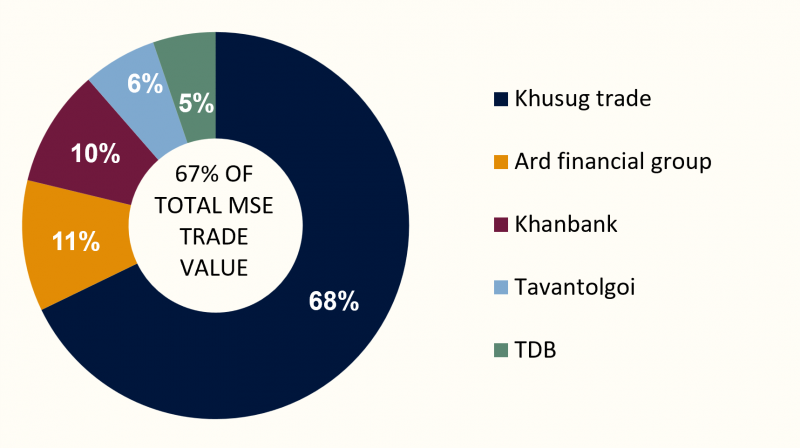
The Mongolian Stock Exchange recorded total trading value of MNT 8 billion during the week, with 8.1 million securities changing hands. Trading activity was concentrated in Khusug trade JSC, Ard financial group JSC, Khan bank JSC, Tavan Tolgoi JSC and TDB JSC, which ranked among the most actively traded stocks by value. The market also registered two block trades during the week, reflecting continued institutional participation.
- Premium Nexus JSC (CUMN): 962 thousand shares traded at MNT 260 per share, with a total transaction value of MNT 250 million.
- Khusug trade JSC (HSG): 83 thousand shares traded at MNT 48,200 per share, with a total transaction value of MNT 4 billion.
Last week, declines continued to dominate the domestic stock market. The TOP-20 and MSE B indices fell, while the MSE A Index closed slightly higher. As it did two weeks ago, the FTI Index, which is based on foreign markets, fell significantly, this time because of a sharp sell-off in technology stocks on global equity markets.
The TOP-20 Index fell 0.39% to 66,788.80 points. The index declined for a second consecutive week, but the pace of decline slowed, which suggests that selling pressure on large-cap stocks may be easing. The MSE A Index edged up 0.11% to 24,980.89 points, while the MSE B Index dropped 3.05% to 14,588.29 points. The MSE B Index posted the largest decline among the domestic indices, a sign that demand for small-cap stocks remains weak.
The FTI Index fell 5.90% to 933.22 points, driven by a sharp drop in AI-related stocks on the US stock market. Although NVIDIA's quarterly revenue beat expectations, semiconductor stocks fell sharply after the company disclosed substantial lease and cloud service commitments. Continued strong expectations that the US Federal Reserve will raise interest rates in December put additional pressure on the market. According to TradingKey, the Nasdaq Composite fell about 10% and the S&P 500 dropped more than 8% during the week.
| INDEX | POINTS | WEEKLY CHANGE |
| TOP 20 Index | 66,788.80 | -0.39% |
| MSE A Index | 24,980.89 | +0.11% |
| MSE B Index | 14,588.29 | -3.05% |
| FTI Index | 933.22 | -5.90% |
⇒ INFLATION CONTINUES TO SQUEEZE MONGOLIAN HOUSEHOLDS
Mongolia’s economy expanded by 7.3% in the first nine months of 2026, driven largely by strong mining exports. However, the benefits of growth have yet to reach many households as persistent inflation continues to erode purchasing power.
According to the National Statistics Office, average monthly real household income declined 2.2% year on year, falling by 61,100 tugrik to 2.7 million tugrik. Real income also slipped 0.3% from the previous quarter, highlighting the ongoing pressure on household finances.
Despite robust economic growth, annual inflation of 13.4% has limited income gains and weakened living standards. Household spending has also softened, with average monthly cash expenditure falling to 2.4 million tugrik.
Consumer spending patterns show growing financial strain. Expenditure on non-food goods and services dropped sharply, while spending on food increased 2%, reflecting higher prices for essential items. Mongolian households now spend an average of 873,000 tugrik per month on food, placing a heavier burden on lower-income families.
Food price inflation remains a major concern. In October, food inflation reached 19.8% nationwide and 25.1% in the western region, intensifying pressure on household budgets and widening affordability challenges across the country.
⇒ KAKAOBANK ACQUIRES 15% STAKE IN M BANK THROUGH STRATEGIC PARTNERSHIP
South Korea’s KakaoBank, one of the world’s leading digital banks, has signed an agreement to acquire a 15% stake in M Bank, Mongolia’s first fully digital bank. The partnership aims to strengthen digital banking capabilities, enhance credit risk assessment, and improve financial inclusion.
Under the agreement, M Bank will leverage KakaoBank’s technology and expertise to expand digital financial services for retail customers and small and medium-sized enterprises (SMEs).
A key focus of the collaboration is the introduction of a more flexible credit-scoring system for individuals with limited or no credit history. This is expected to improve access to financing for underserved segments of the population.
- KakaoBank’s Stake in M Bank: 15%
- KakaoBank Customers: 27+ million
- KakaoBank Assets: Approximately US$60 billion
- Strategic Partner in Mongolia: M Bank
⇒ GOVERNMENT BACKS PROPOSAL TO RESOLVE BANK OF MONGOLIA'S MNT 6.9 TRILLION ACCUMULATED LOSS
The Bank of Mongolia's accumulated losses for 2012–2025 have reached MNT 6.9 trillion, and its capital shortfall stands at MNT 4.8 trillion. The main cause is MNT 15.8 trillion in quasi-fiscal financing that the central bank has provided since 2012 through programs such as mortgage lending and price stabilization.
To address the issue, the Government has backed a proposal to issue MNT 1.5 trillion in special 25-year government securities each year and transfer them to the Bank of Mongolia. Because no principal or interest payments will be made during the first five years, the plan will create no direct cost to the state budget in 2027–2031.
The measure aims to restore the central bank's financial capacity and make its anti-inflation policy more effective. As of October 2026, annual inflation stood at 13.4%. The economy grew 7.6%, but real household income fell 4.8%.
Global equity markets experienced a significant selloff during the week of November 16-20, 2026, driven primarily by a sharp reassessment of AI-related investments. U.S. technology stocks led the downturn, with the Nasdaq falling 9.00%, while the S&P 500 entered correction territory after declining 8.03%. European markets followed the U.S. lower as semiconductor and technology stocks posted their steepest declines in years. Asian markets were similarly affected, particularly Japan and South Korea, whose technology-heavy indexes dropped approximately 8%. In contrast, Chinese equities proved comparatively resilient, supported by policy measures and more attractive valuations, limiting losses in the CSI 300 and Shanghai Composite. Across regions, concerns about the sustainability of AI spending, hawkish central bank expectations, and slowing global growth expectations were the primary drivers of market weakness.
U.S. STOCK MARKET
- S&P 500: -8.03%
- Dow Jones: -7.88%
- Nasdaq: -9.00%
The S&P 500 recorded its worst weekly decline in more than 18 months as investors aggressively unwound AI-related positions. Concerns surrounding the sustainability of AI spending, weakness in semiconductor stocks, and a sharp selloff in Nvidia and other technology leaders triggered broad risk-off sentiment. Hawkish Federal Reserve commentary and persistent inflation concerns further pressured equities.
The Dow fell sharply amid broad market de-risking, concerns over tighter monetary policy, and growing worries that slowing AI-related investment could weaken economic growth. Cyclical sectors such as industrials and financials experienced significant selling pressure.
The Nasdaq posted its worst weekly performance since March 2020 as technology and semiconductor stocks led the decline.
EUROPEAN STOCK MARKET
- FTSE 100: -5.10%
- STOXX Europe 600: -5.80%
- DAX 40: -7.36%
- CAC 40: -5.46%
The FTSE 100 declined as global risk aversion spread from U.S. technology markets. Mining, banking, and cyclical stocks weakened amid concerns over global growth and tighter monetary conditions.
European equities suffered their steepest weekly drop since early 2025 as investors unwound AI-related positions. Semiconductor and technology shares experienced significant declines, while fears of slowing global growth weighed on cyclical sectors.
Germany's export- and technology-sensitive market underperformed as major industrial and semiconductor companies faced heavy selling. Investors also became increasingly concerned about weaker global demand and a deteriorating outlook for technology spending.
The French market was dragged lower by substantial losses in technology, industrial, and luxury shares. Market sentiment deteriorated as investors reduced exposure to growth-oriented sectors amid rising macroeconomic uncertainty.
ASIAN STOCK MARKET
- Nikkei 225: -8.01%
- KOSPI: -8.21%
- CSI 300: -0.76%
- SSEC: -2.15%
Japanese equities fell sharply as global technology and semiconductor stocks sold off. Heavy foreign investor selling and growing concerns about the outlook for AI-related demand pressured major exporters and chip-related companies.
South Korea's technology-heavy market was hit by steep declines in semiconductor and electronics stocks. Weak sentiment toward the global AI sector and concerns over U.S. regulatory scrutiny of chipmakers contributed to the selloff.
Mainland Chinese large-cap stocks demonstrated relative resilience compared with global peers. Ongoing policy support measures, attractive valuations, and expectations for further market stabilization helped limit losses despite global risk-off sentiment.
The Shanghai market declined amid global equity weakness and tighter overseas liquidity expectations. However, losses were moderated by supportive domestic policies and investor confidence that China's economic fundamentals remained relatively stable.
⇒ ️ GLOBAL BANKS FORECAST CONTINUED YUAN APPRECIATION THROUGH 2027
Major global investment banks expect the Chinese yuan to maintain its appreciation trend through 2027, supported by strong export performance and China's substantial trade surplus.
Analysts broadly anticipate that the People's Bank of China (PBOC) will continue to guide the currency higher at a gradual pace. However, the central bank's recent decision to increase foreign-currency reserve requirements for financial institutions suggests policymakers remain cautious about excessive volatility and overly rapid gains in the yuan.
The yuan has strengthened 4.8% against the U.S. dollar year-to-date. According to the median forecast of six global investment banks, the currency is expected to reach 6.44 per dollar by the end of 2027, representing an additional 3.6% appreciation from Friday's closing level of 6.6691 per dollar.
⇒ OIL HEADS FOR THIRD STRAIGHT WEEKLY LOSS ON GROWING SUPPLY OUTLOOK
Crude oil hovered near $82 per barrel on Friday, its lowest level in almost three months, and remained on course for a third consecutive weekly decline as expectations of ample global supply outweighed concerns over possible renewed US action against Iran.
US Energy Secretary Chris Wright stated that oil shipments through the Strait of Hormuz had reached record highs as Middle Eastern production continued to recover. In addition, the US, China, and Russia agreed during a trilateral meeting on Thursday (November 19, 2026) to increase the production and supply of refined petroleum products.
Earlier this week, the International Energy Agency (IEA) forecast a global oil surplus of roughly 2 million barrels per day for the current quarter, while Goldman Sachs cautioned that excess supply could persist into next year. On the geopolitical front, President Donald Trump indicated that he was not rushing to decide on Iran, despite reports suggesting a rising possibility of another round of US strikes in recent days.