Weekly market news 16/11/2026
Weekly market news 16/11/2026

- Overview of the Mongolian Stock Exchange
- Mongolia’s exports increased by 46% year-over-year
- Oyu Tolgoi LLC officially announces plans to distribute dividends starting in 2027
- Government domestic securities trading continues
- AI rally faces key test as Anthropic IPO and NVIDIA earnings loom
- BoE signals more rate hikes as inflation risks persist
- Overview of global stock markets
► MONGOLIAN STOCK EXCHANGE
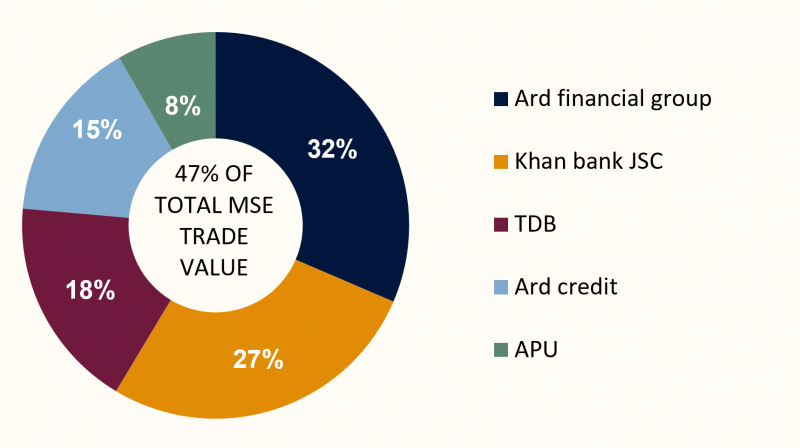
The Mongolian Stock Exchange recorded total trading value of MNT 4 billion during the week, with 7.8 million securities changing hands. Trading activity was concentrated in Ard financial group, Khan bank JSC, TDB, Ard Credit, and APU, which ranked among the most actively traded stocks by value. The market also registered one block trades during the week, reflecting continued institutional participation.
- Ard financial group (AARD): 40,000 shares traded at MNT 6,250 per share, with a total transaction value of MNT 250 million.
Last week, declines dominated the domestic stock market, with the TOP-20, MSE A and MSE B indices all closing lower. In contrast, the FTI Index, which is based on foreign markets, rose as global equity markets recovered. In the previous week, large-cap stocks had supported the market. This week, however, selling pressure spread to those stocks as well, and investors were cautious across the market.
The TOP-20 Index decreased by 1.17% from the preceding week, closing at 67,050.98 points. Similarly, the MSE A Index fell by 1.25% to 24,952.82 points, while the MSE B Index declined by 0.25% to 15,047.29 points. In contrast, the FTI Index delivered the strongest performance of the week, advancing by 3.94% to close at 991.69 points.
| INDEX | POINTS | WEEKLY CHANGE |
| TOP 20 Index | 67,050.98 | -1.17% |
| MSE A Index | 24,952.82 | -1.25% |
| MSE B Index | 15,047.29 | -0.25% |
| FTI Index | 991.69 | +3.94% |
⇒ MONGOLIA’S EXPORTS INCREASED BY 46% YEAR-OVER-YEAR
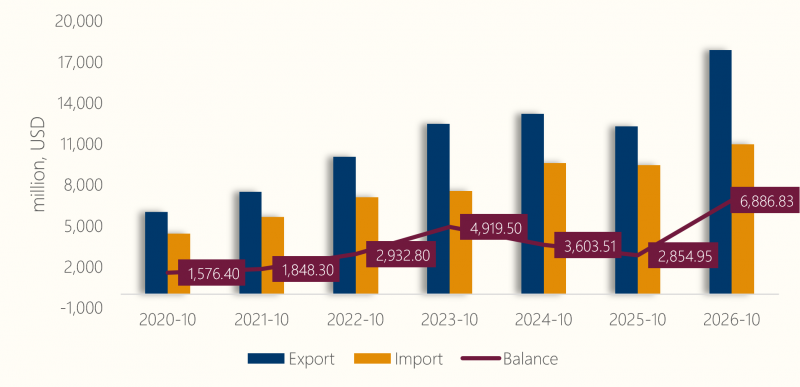
Mongolia’s exports reached USD 17.8 billion in the first ten months of 2026, up 46% from the same period last year. Copper concentrate (42.7%) and coal (37.1%) made up the largest shares of total export revenue.
According to the General Customs Administration, Mongolia exported USD 7.62 billion worth of copper concentrate and USD 6.62 billion worth of coal during the reporting period. Together, these two products accounted for nearly 80% of total export value.
Imports reached USD 10.9 billion in the first ten months of 2026, up 17.1% from the same period last year. Petroleum products made up the largest share of total imports at 24.1%, worth approximately USD 2.6 billion. During the reporting period, Mongolia imported 1.7 million tonnes of diesel fuel and 756.4 thousand tonnes of gasoline, up 14.2% and 11.5% respectively from a year earlier. Food imports also increased, with wheat imports rising 8.4-fold to 142 thousand tonnes.
Mongolia’s total foreign trade turnover reached USD 28.8 billion, up 33.5% year-on-year, and the country recorded a trade surplus of USD 6.9 billion. Exports grew 46%, about 2.7 times faster than imports (17.1%), which was the main driver of the larger trade surplus.
⇒ OYU TOLGOI LLC OFFICIALLY ANNOUNCES PLANS TO DISTRIBUTE DIVIDENDS STARTING IN 2027
Oyu Tolgoi LLC has formally announced in a letter that it plans to begin distributing dividends to its shareholders starting in 2027. A working group led by Minister of Finance Z. Mendsaikhan is currently reviewing the matter and developing proposals regarding the mechanism and schedule for dividend distribution.
The issue was discussed during a joint meeting of the Standing Committee on Economics and the Standing Committee on Petitions held on November 11, where lawmakers reviewed a public petition concerning a matter of broad public interest.
Specifically, lawmakers discussed a proposal to draft legislation that would provide each citizen with MNT 857,000 from the projected MNT 3 trillion in profits expected from the Oyu Tolgoi project through transfers to individual accounts.
⇒ GOVERNMENT DOMESTIC SECURITIES TRADING CONTINUES
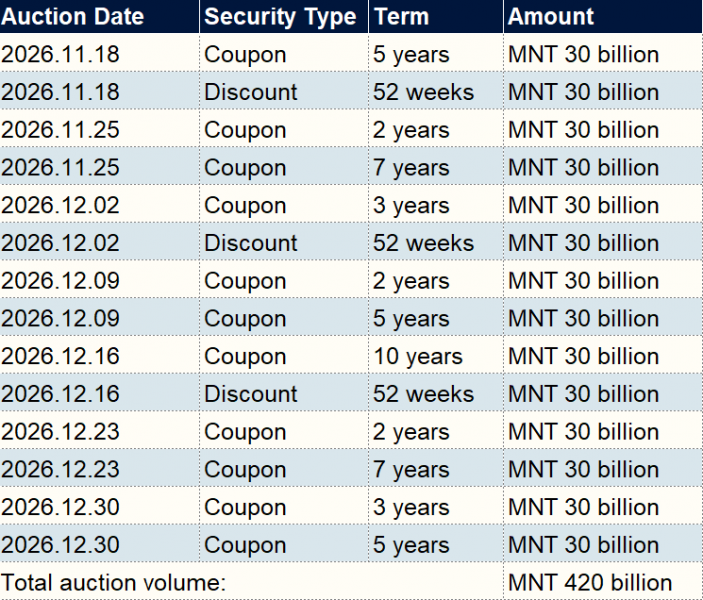
Primary market auctions of Government Domestic Securities (GDS) continue to be held regularly on the Mongolian Stock Exchange. From January to October 2026, a total of MNT 228.5 billion worth of GDS was traded on the primary market.
Trading has remained steady at an average of around MNT 19.4 billion per month. Volumes reached MNT 29.1 billion in April and MNT 44.1 billion in October, making October the highest month of the year so far. These figures show that investor demand for low-risk, fixed-income instruments remains stable.
GDS are low-risk investment instruments backed by the Government of Mongolia that offer fixed interest income. Individuals and legal entities can take part in GDS primary market auctions through MICC Securities.
Please find below the auction schedule through the end of December 2026.
Global equity markets delivered mixed but generally positive results during the week ended 13 November 2026. U.S., European, Japanese, and South Korean equities posted solid gains, while Chinese markets underperformed amid ongoing concerns regarding economic growth and investor confidence. Market sentiment was influenced by inflation data, expectations for monetary policy, developments in the technology sector, and regional economic conditions.
U.S. STOCK MARKET
- S&P 500: +1.88%
- Dow Jones: +1.36%
- Nasdaq: +1.45%
U.S. equities recorded a strong weekly advance despite weakness at the end of the week. Investor sentiment was supported by broad-based buying across sectors, with gains extending well beyond the largest technology stocks. Strong earnings expectations and continued confidence in the U.S. economy helped lift the major indices. However, markets also faced headwinds from stronger-than-expected October inflation data, which reinforced expectations that interest rates could remain elevated for longer. In addition, the resignation of Nvidia CEO Jensen Huang triggered a sharp decline in Nvidia shares and weighed on the technology sector. Nevertheless, gains in other large-cap companies and cyclical sectors more than offset these concerns, allowing the S&P 500, Dow Jones, and Nasdaq to finish the week higher.
EUROPEAN STOCK MARKET
- FTSE 100: +2.11%
- STOXX Europe 600: +2.45%
- DAX 40: +6.21%
- CAC 40: +3.23%
European equities posted one of their strongest weekly performances in several months as investors rotated away from highly valued U.S. technology stocks and into European markets. The rally was supported by relatively resilient economic data, including stronger UK growth figures, and by rising energy prices that boosted the region's energy sector. The STOXX Europe 600 reached record highs during the week, reflecting broad-based gains across industries. Germany's export-oriented market outperformed, helping the DAX deliver the strongest return among major European indices. Overall, improving investor confidence, sector rotation, and expectations of stable corporate earnings drove European market gains.
ASIAN STOCK MARKET
- Nikkei 225: +5.49%
- KOSPI: +5.09%
- CSI 300: -1.23%
- SSEC: -0.67%
Asian equity markets delivered mixed performance during the week. Japan and South Korea outperformed, while Chinese equities weakened amid economic concerns. Investor sentiment was driven by developments in the technology sector, expectations for global interest rates, and regional growth prospects. Japan's Nikkei 225 gained approximately 5.5%, supported by improving risk appetite, positive corporate earnings expectations, and strength in export-oriented sectors. South Korea's KOSPI rose about 5.1% as investors remained optimistic about the semiconductor industry and broader technology supply chain.
⇒ ️ BOE SIGNALS MORE RATE HIKES AS INFLATION RISKS PERSIST
The Bank of England (BoE) has reinforced its commitment to tackling inflation, with policymaker Megan Greene arguing that taking early action is less risky than waiting and allowing price pressures to become entrenched.
Greene, who supported the BoE's decision to raise interest rates to 4.0% from 3.75% at its November meeting, said policymakers should focus on minimizing the risk of making a larger policy mistake. In an environment where the inflation outlook remains uncertain, she believes it is preferable to raise rates aggressively now and reverse course later if necessary, rather than delay action and risk inflation remaining elevated for longer.
According to Greene, the greater danger lies in failing to contain inflation after more than five years of price growth exceeding the central bank's target. She noted that proactive policy tightening can help prevent wage growth from becoming stuck at elevated levels and reduce the likelihood of companies passing higher labor costs on to consumers.
Market expectations appear to align with this view. Investors are currently pricing in another quarter-point rate increase at the BoE's December meeting, followed by as many as two or three additional hikes during 2027.
Adding to the hawkish outlook, BoE Chief Economist Huw Pill indicated that further monetary tightening may be required next year beyond any increase expected in December, signaling that the fight against inflation is far from over.
⇒ AI RALLY FACES KEY TEST AS ANTHROPIC IPO AND NVIDIA EARNINGS LOOM
Investor confidence in the artificial intelligence sector is facing a crucial test this week as two major developments take center stage: Anthropic’s highly anticipated stock market debut and Nvidia’s upcoming quarterly earnings report.
Anthropic, the developer of the Claude chatbot, is expected to make its Nasdaq debut on Thursday with a valuation of up to $1.4 trillion, underscoring continued enthusiasm for leading AI companies.
At the same time, Nvidia, one of the industry's most influential players, is set to release its earnings on Tuesday. The results come amid uncertainty following the unexpected resignation of longtime CEO Jensen Huang, a figure widely regarded as one of the strongest advocates for the AI revolution.
Together, these events are expected to serve as a key gauge of market sentiment toward AI-related investments, which have experienced heightened volatility in recent weeks amid concerns over whether the industry's massive spending levels can be sustained.
Given Nvidia’s deep connections across the AI ecosystem, its earnings report is likely to have far-reaching implications for technology markets and will place additional scrutiny on interim CEO Colette Kress as she takes the helm during a period of transition.