Weekly market news 02/11/2026
Weekly market news 02/11/2026

- Overview of the Mongolian Stock Exchange
- "Premium Nexus" JSC reports 24% increase in revenue
- Monlogistics Group reports strong revenue and profit growth in 2026
- Trading of Invescore NBFI JSC shares temporarily suspended
- FED holds rates steady at 3.75%-4.00%, emphasizes inflation fight
- Hong Kong keeps rates unchanged in line with Federal Reserve Decision
- Germany urges China to ensure balanced economic relations
- Overview of global stock markets
► MONGOLIAN STOCK EXCHANGE
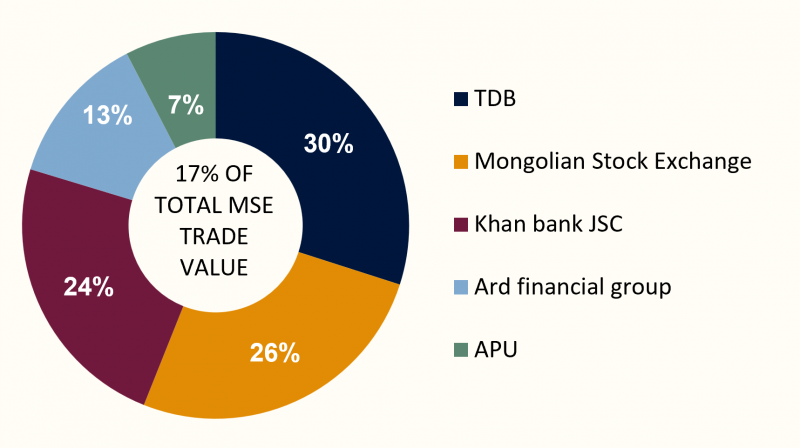
The Mongolian Stock Exchange recorded total trading value of MNT 27.3 billion during the week, with 9.3 million securities changing hands. Trading activity was concentrated in TDB, Mongolian Stock Exchange, Khan bank JSC, Ard financial group, and APU, which ranked among the most actively traded stocks by value. The market also registered two block trades during the week, reflecting continued institutional participation.
- Mongolian Stock Exchange (MSE): 1.46 million shares traded at MNT 339.2 per share, with a total transaction value of MNT 493.7 million.
- Mongolian Stock Exchange (MSE): 1.46 million shares traded at MNT 346.53 per share, with a total transaction value of MNT 504.4 million.
The stock market recorded mixed performance over the past week, with the TOP-20 and FTI indices closing higher, while the MSE A and MSE B indices declined. The TOP-20 Index reached 67,555.17 points, gaining 0.34% from the previous week. This indicates relatively positive momentum among large-cap stocks with higher market capitalization. The MSE A Index fell by 5.41% to 25,295.28 points, marking the largest decline among the major indices during the week. Meanwhile, the MSE B Index decreased by 1.56% to 15,187.54 points. Overall, gains in large-cap stocks provided support to the market, although selling pressure remained more pronounced in the mid- and small-cap segments.
| INDEX | POINTS | WEEKLY CHANGE |
| TOP 20 Index | 67,555.17 | +0.34% |
| MSE A Index | 25,295.28 | -5.41% |
| MSE B Index | 15,187.54 | -1.56% |
| FTI Index | 1,037.32 | +2.40% |
⇒ "PREMIUM NEXUS" JSC REPORTS 24% INCREASE IN REVENUE
"Premium Nexus" JSC, the operator of the CU convenience store chain in Mongolia, reported that the total number of CU stores nationwide reached 651 as of the third quarter of 2026, while cumulative customer visits climbed to 62.4 million. The company’s revenue for the first nine months of 2026 increased by approximately 24% year-over-year, reaching MNT 725.7 billion. However, net profit declined 5.2% from the same period a year earlier to MNT 24.9 billion, according to the company’s financial report. Performance data from 515 stores that operated continuously throughout the third quarters of both 2025 and 2026 showed growth across key operating metrics, including average daily customer traffic, sales volume, and average transaction value. During the reporting period, "Premium Nexus" JSC opened 117 new stores and closed 11 locations, expanding its footprint to 16 provinces across Mongolia. Meanwhile, shares of "Premium Nexus" JSC have declined approximately 5% year-to-date, with the stock most recently closing at around MNT 300 per share.
⇒ MONLOGISTICS GROUP REPORTS STRONG REVENUE AND PROFIT GROWTH IN 2026
"Monlogistics Group" reported revenue of MNT 267.6 billion as of the third quarter of 2026, representing a 24% increase year-over-year. The company's net profit rose 22.4% from the same period last year to approximately MNT 12.4 billion. During the reporting period, the group's total freight volume reached 658,000 tonnes, up 8.4% compared with a year earlier. While export freight volumes declined 64.8% year-over-year, import freight volumes increased 18.3%, reflecting shifting trade dynamics. Notably, the company's international freight operations expanded by 297.2% over the period. The company also highlighted several large-scale logistics projects completed during the quarter. These included the transportation of 115-tonne mining ore crushing and grinding equipment from Germany to Mongolia, as well as transformer equipment for a battery energy storage system with 50 MW of power capacity and 200 MWh of energy storage, delivered from China. The results underscore continued growth in Monlogistics Group's logistics operations, supported by rising import demand and a significant expansion in international freight services.
⇒ TRADING OF INVESCORE NBFI JSC SHARES TEMPORARILY SUSPENDED
Pursuant to Resolution No. 450 dated October 22, 2026, the Financial Regulatory Commission (FRC) approved the subdivision of 75,744,281 ordinary shares of InvesCore NBFI JSC, each with a nominal value of MNT 227, into 757,442,810 ordinary shares with a nominal value of MNT 22.7 per share, representing a 10-for-1 stock split.
connection with the amendment to the company's securities registration arising from this decision, trading of InvesCore NBFI JSC shares has been temporarily suspended effective October 28, 2026, pursuant to Official Notice No. 155 issued by an FRC State Inspector on the same date. Further announcements regarding the resumption of trading will be provided by the relevant authorities upon completion of the securities registration amendment process.
Global equity markets delivered mixed performance last week. Investor sentiment continued to be shaped by assessments of the global economic outlook, the direction of monetary policy, and expectations for corporate earnings growth. Weakness in the technology sector weighed on U.S. markets, while gains in the financial, industrial, and consumer sectors supported European equities. In Asia, differences in economic conditions across countries became increasingly evident, resulting in divergent market performances across the region. Overall, the week highlighted contrasting trends across major markets, with sector-specific and regional factors playing a key role in driving investor sentiment and market movements.
U.S. STOCK MARKET
- S&P 500: -0.78%
- Dow Jones: -1.05%
- Nasdaq: -2.27%
The U.S. stock market posted a broadly negative performance last week. Investors became more cautious about the growth trajectory of major technology companies and the sustainability of elevated expectations surrounding artificial intelligence, leading to a partial shift away from riskier assets. At the same time, relatively high market valuations encouraged profit-taking activities, putting additional pressure on technology stocks. As a result, the Nasdaq Index, which has a heavy weighting of technology companies, fell 2.27%, making it the weakest-performing major index of the week. The S&P 500 Index also declined 0.78%, reflecting selling pressure across the broader market. Meanwhile, the Dow Jones Industrial Average decreased 1.05%. Although industrial, financial, and defensive sector stocks remained relatively resilient, their performance was not sufficient to offset the broader market decline. Market participants continue to closely monitor the outlook for economic growth, the future direction of monetary policy, and corporate earnings prospects, all of which remain key factors influencing investor sentiment.
EUROPEAN STOCK MARKET
- FTSE 100 : +0.36%
- STOXX Europe 600: +1.78%
- DAX 40: +2.31%
- CAC 40: +1.96%
European stock markets delivered a broadly positive performance last week. Investor sentiment was supported by corporate earnings results that exceeded expectations and by growing confidence that the monetary policy environment is becoming more stable. In addition, stable energy prices and stronger-than-expected economic activity across Europe encouraged investors to take on more risk. As a result, the DAX 40 Index, which tracks Germany’s leading companies, rose 2.31%, recording the strongest gain among the major European indices. France’s CAC 40 Index advanced 1.96%, while the STOXX Europe 600 Index, which measures the performance of 600 large European companies, gained 1.78%. Meanwhile, the United Kingdom’s FTSE 100 Index increased 0.36%, posting a more modest but steady rise compared with its European peers. Overall, European equity markets ended the week on a positive note, with gains in the industrial, financial, and consumer sectors providing broad support to market performance.
ASIAN STOCK MARKET
- Nikkei 225: +1.35%
- KOSPI: +4.21%
- CSI 300: -2.28%
- SSEC: -1.96%
Asian stock markets displayed mixed performance last week, as varying economic outlooks, monetary policy expectations, and investor risk appetite influenced markets across the region differently. Strong performance from technology and export-oriented companies supported the Japanese and South Korean markets, while concerns over China's economic growth weighed on Chinese equities. As a result, South Korea’s KOSPI Index rose 4.21%, delivering the strongest performance among the major Asian indices. Japan’s Nikkei 225 Index also advanced 1.35%, supported by gains in export-driven and technology-related stocks. In contrast, Chinese markets posted weaker results, with the CSI 300 Index declining 2.28% and the Shanghai Composite Index falling 1.96%. Overall, Asian equity markets showed a mixed trend during the week. Japanese and South Korean markets benefited from stronger investor sentiment and solid corporate performance, while Chinese markets faced selling pressure amid ongoing concerns about economic growth and market confidence.
⇒ ️ FED HOLDS RATES STEADY AT 3.75%-4.00%, EMPHASIZES INFLATION FIGHT
The U.S. Federal Reserve left its benchmark federal funds rate unchanged at 3.75%-4.00% during its October meeting, following a 25-basis-point increase in September that marked the central bank's first-rate hike since 2023.
The decision was broadly anticipated by markets, although two policymakers dissented in favor of an additional 25-basis-point increase.
In its policy statement, the Fed noted that the U.S. economy continues to expand at a solid pace despite elevated uncertainty stemming partly from geopolitical developments. Consumer spending has remained resilient, while labor market conditions have stayed stable, with job growth keeping pace with labor force expansion and the unemployment rate showing little change.
However, the central bank acknowledged that inflation remains above its target, reinforcing its commitment to restoring price growth to the 2% objective. Officials indicated that incoming economic data will guide future policy decisions and help determine the appropriate stance needed to achieve price stability.
Separately, Federal Reserve Chair Warsh announced that beginning in 2027, the central bank will reduce the number of policy meetings at which members formally vote on interest rate decisions.
⇒ HONG KONG KEEPS RATES UNCHANGED IN LINE WITH FEDERAL RESERVE DECISION
The Hong Kong Monetary Authority (HKMA) maintained its base interest rate at 4.25%, mirroring the U.S. Federal Reserve’s decision to leave policy rates unchanged. Hong Kong’s monetary policy remains closely aligned with that of the United States due to the Hong Kong dollar’s currency peg to the U.S. dollar within the 7.75-7.85 trading band. As a result, changes in U.S. interest rates typically influence monetary conditions in the city. Following the announcement, the Hong Kong dollar traded at 7.8452 per U.S. dollar.
In a statement, the HKMA noted that the outlook for U.S. monetary policy remains uncertain and will largely depend on the trajectory of inflation, labor market conditions, and other key economic indicators. Any adjustments by the Federal Reserve could, in turn, affect Hong Kong’s interest rate environment.
The authority also emphasized that the future path of the Hong Kong dollar and local interbank rates will be influenced by a range of factors, including investor appetite for carry trades, liquidity conditions in the Hong Kong dollar market, capital market activity, and seasonal fluctuations in funding demand. The decision underscores Hong Kong’s commitment to maintaining monetary stability under its linked exchange rate system while remaining responsive to evolving global financial conditions.
⇒ GERMANY URGES CHINA TO ENSURE BALANCED ECONOMIC RELATIONS
German President Frank-Walter Steinmeier called on China to ensure that its drive for greater economic self-reliance does not result in excessive dependence by other countries, emphasizing the importance of maintaining balanced and mutually beneficial trade relationships.
Speaking at Peking University ahead of his scheduled meeting with Chinese President Xi Jinping, Steinmeier acknowledged China's efforts to strengthen its resilience against external economic shocks. However, he stressed that increased autonomy for China should not come at the expense of creating vulnerabilities for its trading partners.
His remarks reflected growing European concerns over trade imbalances with China. The European Union has repeatedly described its expanding trade deficit with China as unsustainable and has indicated its readiness to deploy a broad range of measures to address the issue.
Steinmeier highlighted longstanding concerns among European businesses regarding limited access to the Chinese market, while European economies continue to face a surge of state-supported Chinese imports and restrictions on exports of key raw materials from China.
Despite these challenges, the German president reaffirmed Europe’s commitment to safeguarding its industrial competitiveness and expressed confidence that Brussels and Beijing could resolve differences through constructive dialogue.