Weekly market news 19/10/2026
Weekly market news 19/10/2026

- Overview of the Mongolian Stock Exchange
- “SUU 2.0” Plant Officially Opens
- State Bank’s Net Profit Surges 78.7% to MNT 102.7 Billion
- Asian Bonds See Largest Foreign Outflow Since 2020
- IMF Warns of Rising Risks to Global Financial Stability
- China's Trade Surplus Surges as Exports Accelerate
- Overview of global stock markets
► MONGOLIAN STOCK EXCHANGE
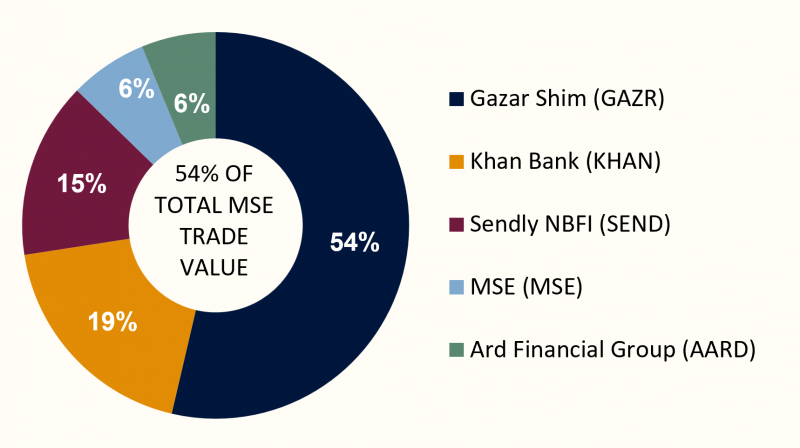
The Mongolian Stock Exchange recorded total trading value of MNT 16.27 billion during the week, with 168.64 million securities changing hands. Trading activity was concentrated in Gazar Shim (GAZR), Khan Bank (KHAN), Sendly (SEND), Mongolian Stock Exchange (MSE), Ard Financial Group (AARD), which ranked among the most actively traded stocks by value. The market also registered four block trades during the week, reflecting continued institutional participation.
- Khan Bank JSC (KHAN): 180,761 shares traded at MNT 1773 per share, with a total transaction value of MNT 320,489,253.
- Gazar Shim Uildver JSC (GAZR): 75 million shares traded at MNT 31 per share, with a total transaction value of MNT 2 billion 235 million.
- Sendly NBFI JSC (SEND): 6,118,267 shares traded at MNT 208 per share, with a total transaction value of MNT 1,272,599,536.
- Gazar Shim Uildver JSC (GAZR): 75 million shares traded at MNT 31 per share, with a total transaction value of MNT 2 billion 235 million.
The indices of the showed mixed performance. The TOP 20 Index recorded the strongest performance, increasing by 0.84% to reach 67,276.55 points, while the MSE A Index rose by 0.75% to 26,900.49 points. In contrast, the MSE B Index declined by 1.42% to 15,136.15 points, and the FTI Index fell by 4.15% to 1,024.18 points. Last week's gains were largely driven by the strong performance of stocks in the banking and financial sector.
| INDEX | POINTS | WEEKLY CHANGE |
| TOP 20 Index | 67,276.55 | +0.84% |
| MSE A Index | 26,900.49 | +0.75% |
| MSE B Index | 15,136.15 | -1.42% |
| FTI Index | 1,024.18 | -4.15% |
⇒ “SUU 2.0” PLANT OFFICIALLY OPENS
Suu JSC, one of Mongolia’s leading dairy producers, has officially launched its new fully automated SUU 2.0 plant. The project aims to bring production capacity, product quality, food safety, and operational efficiency up to international standards.
With the commissioning of the new facility, Suu JSC’s daily processing capacity has doubled from 200 tons to 400 tons. The expansion will enable the company to diversify its product range and further develop the production of dairy products for children.
The company has set a goal of fully meeting domestic demand for milk and dairy products within the next two to five years.
The project was implemented with concessional financing under Mongolia’s “Food Revolution” and “Atar IV Campaign” programs. Since 2023, the company has received a total of MNT 58 billion in loans, of which MNT 30 billion has already been repaid.
⇒ STATE BANK’S NET PROFIT SURGES 78.7% TO MNT 102.7 BILLION
State Bank reported a net profit of MNT 102.7 billion in the first nine months of 2026, marking a 78.7% year-on-year increase. The strong performance was driven primarily by growth in net interest income and lower operating expenses.
During the reporting period, the bank’s interest income rose to MNT 768.8 billion, while net interest income increased to MNT 273.1 billion. The bank also expanded its balance sheet, with total assets reaching MNT 7.56 trillion and its loan portfolio growing to MNT 4.42 trillion, reflecting continued business growth and lending activity.
State Bank highlighted that it now serves 2.3 million customers through more than 150 products and services, while continuing to enhance its digital banking offerings. Following the earnings announcement, the bank’s share price closed at MNT 590, bringing its year-to-date gain to 19.5%
Global equity markets were mixed during the week of 12-18 October 2026, with the US market declining, European equities advancing modestly, and Asian markets experiencing notable weakness, particularly in Japan.
U.S. STOCK MARKET
- S&P 500: -1.97%
- Dow Jones: +0.46%
- Nasdaq: -4.43%
The S&P 500 fell from 7,813.04 on 12 October to 7,659.44 on 16 October, representing a weekly decline of approximately 1.9%. The broader US market came under pressure from rising Treasury yields, increasing market volatility, and a sharp sell-off in large-cap technology shares. Investor sentiment weakened amid concerns that elevated interest rates could continue to weigh on equity valuations, while profit-taking in AI-related and growth stocks further dampened performance.
EUROPEAN STOCK MARKET
- FTSE 100: +3.13%
- STOXX Europe 600: +1.92%
- DAX 40: +1.65%
- CAC 40: +1.66%
The STOXX Europe 600 rose from 632.58 on 12 October to 644.74 on 16 October, delivering a weekly gain of approximately 1.9%. European markets outperformed their US counterparts as investors favoured value-oriented sectors, particularly financials and energy. Support also came from relatively resilient corporate earnings expectations and continued interest in companies benefiting from higher commodity prices.
ASIAN STOCK MARKET
- Nikkei 225: -0.12%
- KOSPI: -5.94%
- CSI 300: -0.87%
- SSEC: -0.66%
Asian markets showed divergent performance. Japan's Nikkei 225 dropped from 67,866.50 on 12 October to 65,324.29 on 16 October, a decline of approximately 3.75%. The sell-off was driven by weakness in technology and export-oriented stocks, concerns about global demand, and increased risk aversion following falling US technology shares. A stronger yen during parts of the week also weighed on exporters' earnings outlook.
China's major indices were relatively stable, with investor sentiment supported by expectations of further policy support, although gains were constrained by ongoing concerns regarding the property sector and uneven economic recovery.
⇒ ️ IMF WARNS OF RISING RISKS TO GLOBAL FINANCIAL STABILITY
The International Monetary Fund (IMF) has identified three key threats to global financial markets: an AI-driven market correction, higher sovereign bond yields, and growing cyberattack risks. The Fund warns that rising leverage, tighter liquidity and increasing interconnectedness across financial markets could amplify the impact of any shock.
The IMF highlighted growing dependence on AI-related investments, noting that heavy borrowing by data centre operators and investors could leave markets vulnerable if AI earnings fail to meet expectations. A correction in AI-related assets could trigger broader deleveraging across financial markets.
Meanwhile, rising government bond yields driven by inflation pressures and fiscal concerns could weigh on asset valuations and reduce the value of bonds used as collateral throughout the financial system.
Cybersecurity has also emerged as a major systemic risk. The IMF cautioned that attacks on financial institutions, payment systems or critical technology providers could disrupt financial services and undermine market confidence.
⇒ CHINA'S TRADE SURPLUS SURGES AS EXPORTS ACCELERATE
China's trade surplus widened more than expected in September, supported by a sharp rebound in exports. Strong global demand for semiconductors, electric vehicles and other high-tech products helped offset weakness in domestic consumption and investment.
Exports rose 36.3% year-over-year, marking the fastest growth since February, while imports increased 31.0%, signalling continued strength in trade activity. China's trade surplus reached USD 938 billion in the first nine months of 2026, including a USD 133.5 billionsurplus in September alone.
⇒ ASIAN BONDS SEE LARGEST FOREIGN OUTFLOW SINCE 2020
Foreign investors withdrew a net USD 8.2 billion from Asian bond markets in September, marking the largest monthly outflow since March 2020. The sell-off was driven by rising US Treasury yields and expectations of further Federal Reserve rate hikes, which reduced the appeal of emerging-market debt.
The US 10-year Treasury yield climbed to a 24½-year high of 5.36%, fuelled by inflation concerns and elevated oil prices. As a result, investors also pulled capital from regional equities, signalling a broader risk-off sentiment across Asian markets.
South Korea recorded the largest bond outflow, while Thailand, India, Malaysia and Indonesia also saw foreign selling.
Higher US yields continue to attract capital away from emerging markets, creating headwinds for Asian bonds and equities and potentially keeping foreign inflows subdued in the near term.