Weekly market news 05/10/2026
Weekly market news 05/10/2026

- Overview of the Mongolian Stock Exchange
- Bank of Mongolia to Maintain Inflation at Around 5% Over the Medium Term
- Parliament Begins Review of Mongolia’s 2027 State Budget
- AI Debt Boom Drives Yields Higher
- Nvidia announces the largest stock buyback increase in histor
- Overview of global stock markets
► MONGOLIAN STOCK EXCHANGE
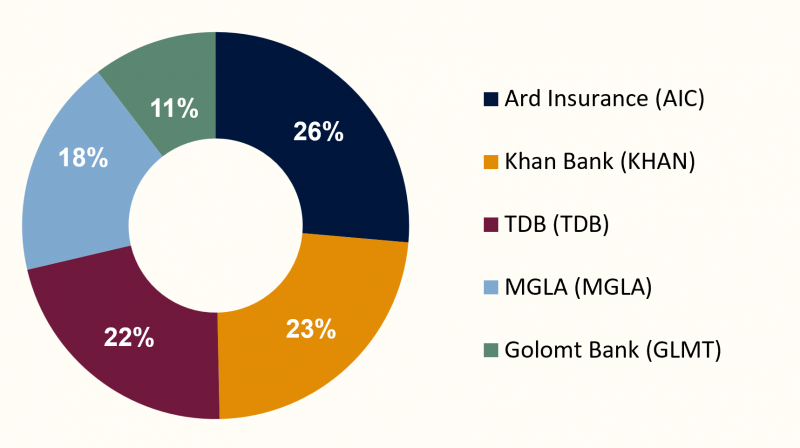
The Mongolian Stock Exchange recorded total trading value of MNT 79.15 billion during the week, with 9.38 million securities changing hands. Trading activity was concentrated in ARD Insurance (AIC), Khan Bank (KHAN), Trade and Development Bank of Mongolia (TDB), MGLA (MGLA), and Golomt Bank (GLMT), which ranked among the most actively traded stocks by value. The market also registered two block trades during the week, reflecting continued institutional participation.
- MGL Aqua JSC (MGLA): 2 million shares traded at MNT 282.4 per share, with a total transaction value of MNT 621 million.
- ARD Insurance JSC (AIC): 1.2 million shares traded at MNT 727 per share, with a total transaction value of MNT 881 million.
Most major indices in the Mongolian stock market closed higher last week. The Top 20 Index posted the strongest performance, rising 0.34% to 66,842.06 points, while the MSE Index gained 0.30% to 15,342.78 points. The FTI Index also increased by 0.24% to 1064.85 points. Meanwhile, the MSE A Index declined by 0.18% to 26294.73 points.
The broad-based gains in the indices indicate a notable increase in investor activity and buying interest in the capital market. In particular, the strong performance of the TOP 20 index suggests increased demand for shares of companies with relatively high market capitalizations and stronger liquidity. Last week’s market growth was largely driven by gains in the banking and financial sectors.
| INDEX | POINTS | WEEKLY CHANGE |
| TOP 20 Index | 66,842.06 | +0.34% |
| MSE A Index | 26,294.73 | -0.18% |
| MSE B Index | 15,342.78 | +0.30% |
| FTI Index | 1,064.85 | +0.24% |
⇒ BANK OF MONGOLIA TO MAINTAIN INFLATION AT AROUND 5% OVER THE MEDIUM TERM
The Bank of Mongolia has submitted its draft monetary policy guidelines for 2027 to Parliament, reaffirming its commitment to keeping inflation at around 5% over the medium term. The central bank emphasized that it will continue pursuing a consistent monetary policy aimed at protecting household purchasing power and maintaining price stability.
The draft also proposes a new approach to tackling inflation by coordinating monetary policy more closely with fiscal discipline, rather than relying solely on central bank measures. In addition, it includes plans to address the central bank's accumulated losses and capital shortfall through special government securities, while strengthening the Bank of Mongolia's institutional independence.
To support financial sector stability, the policy framework outlines 17 policy measures and corresponding performance indicators covering two key areas: price stability and banking sector stability.
If approved, the resolution is expected to support the implementation of the Bank of Mongolia's 2026-2030 Medium-Term Strategic Plan and serve as a starting point for broader legal and regulatory reforms in Mongolia's banking and financial system.
Overall, the Bank of Mongolia aims to maintain inflation at around 5%, improve coordination between monetary and fiscal policies, and accelerate reforms across the financial sector.
⇒ PARLIAMENT BEGINS REVIEW OF MONGOLIA’S 2027 STATE BUDGET
Parliament has begun discussing the draft state budget for 2027. The proposed budget includes total expenditures of MNT 43 trillion and total revenues of MNT 40.7 trillion.
As a result, the budget deficit is projected at MNT 2.3 trillion, equivalent to 2% of GDP. The Government plans to fully finance this deficit through concessional external loans and the issuance of domestic government securities.
Budget revenue is expected to increase by MNT 6.5 trillion compared to the previous level. Of this amount, MNT 3.5 trillion is expected to come from dividends paid by state-owned enterprises, while MNT 3 trillion is projected to be generated from Oyu Tolgoi dividends.
Most of the additional revenue is planned to be allocated to supporting household incomes and social welfare programs. Specifically, MNT 2.9 trillion is earmarked for increasing pensions and social benefits, while MNT 2.6 trillion is allocated to raising salaries and wages for public sector employees.
The main driver across global equity markets was the sharp rise in government bond yields, particularly in the United States. Higher yields increased expectations that interest rates could remain elevated for longer, reducing investor risk appetite and putting pressure on equity valuations. However, technology and AI-related sectors continued to provide support to markets such as Japan and Taiwan.
In the United States, higher Treasury yields weighed on investor sentiment, but strong performance from AI-related technology companies helped limit losses. As a result, the S&P 500 posted only a modest decline as technology stocks outperformed most other sectors.
In Europe, equities underperformed as investors weighed the combined impact of rising borrowing costs and concerns over slowing economic growth. Consequently, major indices including the STOXX Europe 600, DAX, and FTSE 100 all ended the week lower.
In Asia, market performance was mixed. Japan's Nikkei 225 was the strongest performer, supported by continued optimism surrounding technology-related stocks. In contrast, Chinese and Hong Kong markets declined sharply as weak investor confidence and concerns about China's economic outlook continued to weigh on sentiment.
Overall, while technology and AI-related sectors attracted investment, concerns over higher interest rates, slower economic growth, and rising financing costs remained the dominant themes affecting global markets during the week.
U.S. STOCK MARKET
- S&P 500: +0.01%
- Dow Jones: -0.91%
- Nasdaq: +0.95%
The primary market driver was the sharp rise in US Treasury yields, with the benchmark 10-year yield moving above 5%, increasing expectations that interest rates could remain higher for longer. Higher yields typically reduce equity valuations by raising discount rates and making bonds more attractive relative to stocks.
At the same time, the artificial intelligence investment theme remained a significant source of support for technology-related sectors. While rising yields weighed on the broader market, continued optimism around AI spending, data centres, semiconductors and cloud computing helped technology stocks outperform and prevented a deeper market decline.
The Dow was pressured by higher yields and weakness in industrial stocks, whereas the Nasdaq proved more resilient due to sustained investor demand for AI and technology companies.
EUROPEAN STOCK MARKET
- FTSE 100: -2.18%
- STOXX Europe 600: -1.30%
- DAX 40: -0.84%
- CAC 40: -2.64%
The UK market declined as investors reacted to higher global bond yields and concerns over slowing economic growth. The FTSE's large allocation to cyclical sectors and internationally exposed companies left the index vulnerable to weaker global risk sentiment during the week.
European stocks weakened as investors assessed the impact of higher global interest rates on economic activity and corporate earnings. Rising bond yields reduced risk appetite and increased concerns that economic growth across the region could slow further, prompting broad-based selling across sectors.
ASIAN STOCK MARKET
- Nikkei 225: +2.71%
- KOSPI: -0.77%
- CSI 300: -1.50%
- SSEC: -0.93%
The Nikkei 225 was the strongest-performing major Asian index during the week, rising 2.71%. Investor sentiment remained positive towards Japanese equities, particularly technology and export-oriented companies that stand to benefit from continued global demand for AI-related infrastructure and semiconductor products.
South Korea's KOSPI declined 0.77% as investors became more cautious in response to rising global bond yields and concerns about the outlook for global economic growth. Although the market has significant exposure to semiconductor and technology companies, profit-taking and broader risk aversion outweighed support from the technology sector.
The Shanghai Composite Index and The CSI 300 recorded losses during the week, reflecting persistent concerns surrounding domestic economic momentum and corporate earnings prospects. Investors looked for stronger evidence of economic stabilisation, while elevated global interest rates and capital flows towards safer assets further pressured sentiment.
⇒ ️ AI DEBT BOOM DRIVES YIELDS HIGHER
Rising bond issuance to finance AI spending is contributing to higher bond yields. Analysts attribute this trend to the principles of supply and demand. As borrowing needs rise sharply, lenders are able to demand higher interest rates, which in turn pushes up bond yields.
According to LSEG data, five leading AI hyperscalers, Alphabet, Amazon, Meta, Microsoft, and Oracle, have already raised USD 220 billion in debt this year to finance data centers and AI model development. This is more than twice the total amount of debt they raised in the previous year. Additional debt issuance is expected to continue in the coming months.
The estimated USD 270 billion in debt issuance in 2026 is more than four times the previous peak of approximately USD 62 billion in 2020.
⇒ NVIDIA ANNOUNCES THE LARGEST STOCK BUYBACK INCREASE IN HISTORY
NVIDIA's board has authorized an extra $150 billion in stock buybacks, raising the company's total remaining repurchase capacity to $235 billion. The chipmaker expects to complete the program by fiscal 2028.
According to CEO Jensen Huang, the ongoing shift toward AI and accelerated computing continues to drive NVIDIA's growth. The sizeable buyback authorization underscores the company's confidence in future opportunities while maintaining investment in next-generation technologies.
NVIDIA stock is up 2.6% this week and is on track for its third straight weekly advance.
The record buyback signals management's confidence in NVIDIA's future earnings potential and the continued strength of AI-related demand.