Weekly market news 21/09/2026
Weekly market news 21/09/2026

- Overview of the Mongolian Stock Exchange
- Bank of Mongolia keeps policy rate unchanged at 12.5%
- Mongolian capital market 2.0” program announced
- Banks slightly ease lending standards as loan demand increases
- Global Energy Prices Surge Amid Middle East Conflict
- US interest rates raised for first time in three years
- Overview of global stock markets
► MONGOLIAN STOCK EXCHANGE
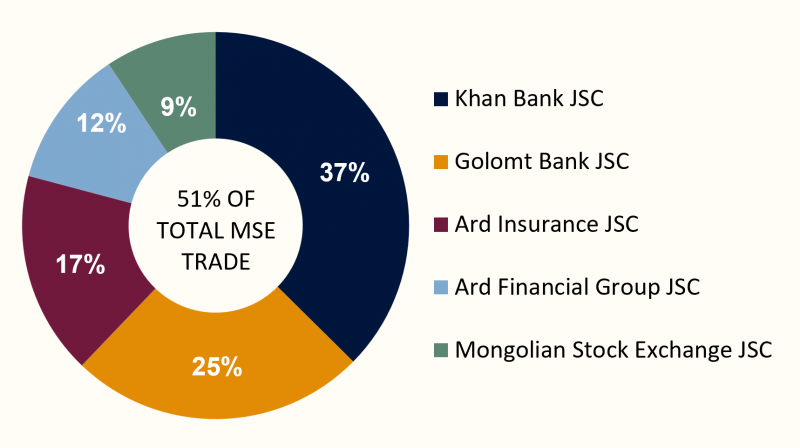
Over the course of the week, a total of 5.9 million securities with a combined value of MNT 4.3 billion were traded on the Mongolian Stock Exchange. By trading value, Khan bank JSC, Golomt Bank JSC, Ard Insurance JSC, Ard Financial Group JSC, and Mongolian Stock Exchange JSC were the most actively traded securities. A total of one block trades were executed during the period, as follows:
- Ard Insurance JSC (AIC) – 492 thousand securities at MNT 680 per share, totaling MNT 334.9 million.
The major indices of the Mongolian stock market moved positively, with the market’s upward trend remaining intact. The TOP-20 Index rose by 2.93% to 64,900.55 points, reflecting increased investor activity and gains in the prices of major listed stocks. Meanwhile, the MSE-A Index increased by 2.17% to 25,001.81 points, indicating stronger demand for shares of highly valued companies. In contrast, the MSE-B Index rose by 0.44%, indicating relatively stable movements in the shares of second- and third-tier companies. Meanwhile, the FTI Index declined by 0.31% to 1,050.41 points.
Overall, the stock market maintained an upward trend during the reporting week, with investor sentiment remaining positive. Major companies included in the TOP-20 and MSE-A indices remained the key drivers of market performance.
| INDEX | POINTS | WEEKLY CHANGE |
| TOP 20 Index | 64,900.55 | +2.93% |
| MSE A Index | 25,001.81 | +2.17% |
| MSE B Index | 15,322.46 | +0.44% |
| FTI Index | 1,050.41 | -0.31% |
⇒ BANK OF MONGOLIA KEEPS POLICY RATE UNCHANGED AT 12.5%
At its meeting held on September 16–17, 2026, the Monetary Policy Committee of the Bank of Mongolia decided to keep the policy rate unchanged at 12.5%.
In August 2026, annual headline inflation stood at 12.5% nationwide and 11.6% in Ulaanbaatar, decreasing by 0.5 and 1.4 percentage points, respectively, from the previous month. The slowdown in inflation was mainly driven by increased supplies of meat and vegetables and a moderation in food price growth.
Mongolia’s economy grew by 7.7% in the first half of 2026, with mining and transportation being the main contributors to growth. Going forward, activity in the mining and transportation sectors is expected to remain strong, while growth in non-mining sectors is projected to gradually increase.
Externally, the conflict in the Middle East continues to pose risks of higher oil and energy prices and increased inflationary pressures. Meanwhile, elevated gold and copper prices are supporting Mongolia’s terms of trade and foreign exchange reserves.
The Bank of Mongolia expects inflation to moderate from the second quarter of 2027 and approach the upper bound of the target range by the end of 2026. However, the revision of the 2026 state budget and the process of approving the 2027 budget remain among the key risks to the inflation outlook.
Accordingly, the Monetary Policy Committee will continue to assess changes in inflation and economic conditions and take appropriate policy measures as necessary.
⇒ "MONGOLIAN CAPITAL MARKET 2.0” PROGRAM ANNOUNCED
On September 15, London Stock Exchange Group (LSEG), the Mongolian Stock Exchange (MSE), and the Central Securities Depository (CSD) announced the launch of the “Mongolian Capital Market 2.0” program. The program is a long-term cooperation initiative aimed at modernizing Mongolia’s capital market technology and infrastructure and strengthening its integration with international markets.
The program will focus on developing trading, clearing and settlement, and securities depository systems in line with international standards, as well as facilitating dual listings of Mongolian companies and attracting greater foreign investment. This is expected to expand opportunities for domestic companies to raise financing from international capital markets and increase investor participation.
According to analysts, the initiative represents an important step toward advancing Mongolia’s capital market by improving market transparency, liquidity, and international competitiveness.
⇒ BANKS SLIGHTLY EASE LENDING STANDARDS AS LOAN DEMAND INCREASES
The Bank of Mongolia’s Bank Lending Survey for the second quarter of 2026 was released last week. The survey is a qualitative study that assesses banks’ lending supply and demand, the factors driving changes in these indicators, and the current and future outlook for the credit market.
In the second quarter of 2026, banks slightly eased lending standards for both businesses and households. Corporate lending conditions also eased slightly, while household lending conditions remained largely unchanged.
Loan demand increased, with the corporate loan demand index reaching 0.34 and the household loan demand index standing at 0.22. The increase in corporate loan demand was mainly driven by financing needs for fixed assets and working capital, while higher consumer confidence, demand for durable goods, and other financial needs were the main factors behind the increase in household loan demand.
In the coming quarter, banks expect to slightly increase lending supply to both businesses and households. The corporate and household loan supply indices both stood at 0.19, with banks expecting a relatively stronger increase in the supply of salary loans to households.
Meanwhile, banks generally expect lending conditions for both businesses and households to remain unchanged in the coming quarter. Corporate lending standards are expected to ease slightly, while household lending standards are expected to remain broadly unchanged.
Equity Markets: Performance was uneven. U.S. indices were mixed (S&P 500 and Nasdaq up slightly, Dow down sharply). Japanese stocks rallied despite yen weakness. Global equity funds saw $23.2B in outflows, the largest in nine months, though Asia attracted inflows.
Central Banks: Major economies tightened policy. The Federal Reserve raised rates to 3.75–4%, the European Central Bank lifted its deposit rate to 2.5%, and the Bank of Japan surprised markets with a hike to 1.25% — its highest in 31 years. These moves reinforced a synchronized tightening cycle.
Commodities: Oil prices remained above $100/barrel due to geopolitical risks. Gold continued to draw safe haven demand, marking its ninth weekly capital inflow out of the past ten weeks.
Bond Markets: Investors shifted toward quality. Government bonds gained inflows, while high yield debt faced withdrawals.
U.S. STOCK MARKET
- S&P 500: +0.51%
- Dow Jones: -2.03%
- Nasdaq: +1.94%
The Nasdaq outperformed, supported by gains in technology stocks. The Dow lagged significantly, falling 2.03% for the week as investors reacted to rising bond yields and concerns about higher interest rates. The week was dominated by the Federal Reserve's rate hike announcement, its first increase since 2023, which increased market volatility.
EUROPEAN STOCK MARKET
- FTSE 100: +0.08%
- STOXX Europe 600: -0.48%
- DAX 40: -0.76%
- CAC 40: -0.83%
The FTSE 100 was the relative outperformer, finishing the week roughly unchanged. The broader STOXX Europe 600 fell about 0.48%, reflecting weakness across most European markets. Germany's DAX 40 underperformed. France's CAC 40 was also weak, declining about 0.83%.
ASIAN STOCK MARKET
- Nikkei 225: +2.14%
- KOSPI: +3.01%
- CSI 300: +0.74%
- SSEC: +1.16%
Japan's Nikkei 225 was one of the strongest performer among these markets, gaining 2.14% for the week. China's broader Shanghai Composite posted a gain of 1.16%, indicating some resilience in the domestic market. Overall, Japan led the major developed Asian markets last week, China was mixed but stable.
⇒ ️ GLOBAL ENERGY PRICES SURGE AMID MIDDLE EAST CONFLICT
Global energy markets are under severe strain as escalating conflict between Yemen’s Houthis and Saudi Arabia disrupts critical oil and gas supply routes. The ripple effects are being felt worldwide, with households and businesses bracing for higher costs and inflationary pressures.
Oil prices have climbed sharply, now sitting above $108 per barrel compared to $70 in June — a nearly 50% increase. This surge has pushed UK petrol prices past 170p per litre, the highest since 2022, while wholesale natural gas costs have almost doubled since July. Regulators forecast that the UK’s domestic energy price cap will rise by 25% in January, adding around £440 a year to household bills. In the US, petrol has risen to $4.32 per gallon, and diesel has hit a record $6+, surpassing levels seen after Russia’s invasion of Ukraine in 2022.
The supply disruptions behind these price spikes are significant. The Strait of Hormuz, once carrying 21 million barrels of oil per day, has seen flows drop to around 8.6 million following Iranian attacks and US blockades. Saudi Arabia’s East-West Pipeline, a vital alternative route with a capacity of 3.6 million barrels per day, was forced offline after drone strikes, with repairs expected to take weeks. Meanwhile, the Houthis have captured territory near the Bab al-Mandab Strait, another chokepoint for global oil trade, raising fears of further disruption. On top of this, Ukrainian drone strikes on Russian refineries have tightened global diesel supplies, adding pressure to already strained markets.
Looking ahead, there is some hope that prices could ease if peace talks between the US and Iran succeed. A preliminary deal in June briefly pushed oil back to pre-war levels after prices had spiked to $120 per barrel. However, without resolution, the world faces sustained inflationary pressure, weaker growth, and rising living costs across multiple sectors.
⇒ US INTEREST RATES RAISED FOR FIRST TIME IN THREE YEARS
The US Federal Reserve raised interest rates from 3.5%-3.75% to 3.75%-4%, marking its first rate increase in more than three years, in an effort to combat persistently high inflation. Fed Chair Kevin Warsh said inflation has remained above the Fed's 2% target for over five years and that higher rates are needed to prevent rising prices from spreading across the economy. While the move is intended to stabilize prices and support long-term economic health, it will make borrowing more expensive for consumers through higher mortgage, loan, and credit card rates, though savers may benefit from better returns.
Most Fed policymakers expect additional rate increases before the end of the year, with possible further hikes next year. They also forecast inflation gradually falling back toward the 2% target by 2029.
The Fed is not alone. Other major central banks, including the European Central Bank, have also raised rates recently in response to rising inflation.