Weekly market news 07/09/2026
Weekly market news 07/09/2026

- Overview of the Mongolian Stock Exchange.
- Tax incentive on income from securities trading extended until 2040
- Bank of mongolia purchases 3.1 tonnes of precious metals in august
- “DBM bond” primary market trading to begin
- Bogd bank’s parent company files with the SEC for NYSE American IPO
- Trump urges the Fed to cut rates, threatening to halt trade with countries running trade surpluses with the U.S.
- AI investment expands as NVIDIA broadens its role across the AI ecosystem.
- Oil prices rise as shipping risks around the strait of hormuz increase.
- Overview of global stock markets.
► MONGOLIAN STOCK EXCHANGE
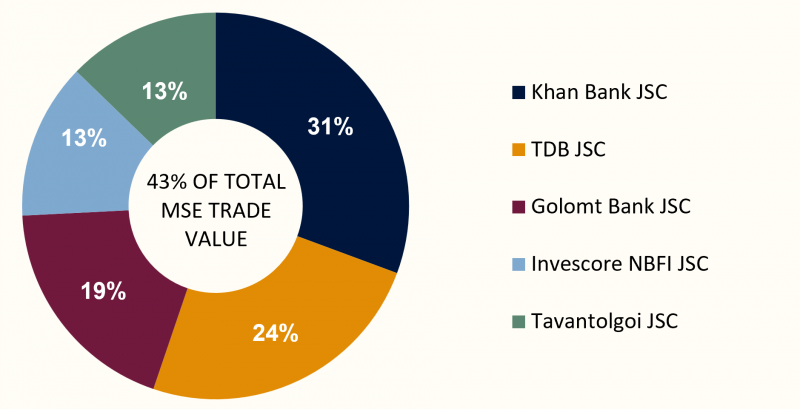
Over the course of the week, a total of 6.4 million securities with a combined value of MNT 8.06 billion were traded on the Mongolian Stock Exchange. By trading value, Khan bank JSC, TDB JSC, Golomt bank JSC, Invescore NBFI JSC, and Tavantolgoi JSC were the most actively traded securities. A total of one block trades were executed during the period, as follows:
- Invescore NBFI JSC (INV) – 43,700 securities at MNT 8,000 per share, totaling MNT 349.6 million.
Most major indices in the Mongolian stock market closed higher last week. The MSE A Index posted the strongest performance, rising 9.72% to 24,429.44 points, while the TOP 20 Index gained 9.59% to 63,412.07 points. The MSE B Index also increased by 0.68% to 15,264.75 points. Meanwhile, the FTI Index declined by 0.49% to 1,066.82 points.
The broad-based gains in the indices indicate a notable increase in investor activity and buying interest in the capital market. In particular, the strong performance of the MSE A and TOP 20 indices suggests increased demand for shares of companies with relatively high market capitalizations and stronger liquidity. Last week’s market growth was largely driven by gains in the banking and financial sectors, as well as mining companies, with the TOP 20 Index reaching a historic high. Tavantolgoi JSC (TTL) led the market, with its share price surging 37.7% in just one week. Its market capitalization reached approximately MNT 3.2 trillion, making it the second-largest company listed on the Mongolian Stock Exchange after Khan Bank (KHAN), and placing it among the first two companies on the MSE with market capitalizations exceeding MNT 3 trillion.
The MSE B Index recorded a relatively modest 0.68% gain, indicating that price movements among mid- and small-cap stocks remained relatively stable.
Meanwhile, the 0.49% decline in the FTI Index suggests a slight downward pressure on the valuation of investment fund units. Nevertheless, the overall market trend remained positive.
| INDEX | INDEX | INDEX |
| TOP 20 Index | 63,412.07 | +9.59% |
| MSE A Index | 24,429.44 | +9.72% |
| MSE B Index | 15,264.75 | +0.68% |
| FTI Index | 1,066.82 | -0.49% |
⇒ TAX INCENTIVE ON INCOME FROM SECURITIES TRADING EXTENDED UNTIL 2040
Under the law enacted on July 3, 2026, the tax incentive period for income derived from the sale of bonds, shares, and other securities publicly traded on the domestic primary and secondary markets has been extended from 2029 to 2040.
Specifically:
- 2024–2034: 90% tax exemption
- 2035–2040: 50% tax exemption
The extension provides a more favorable long-term tax environment for investment in Mongolia’s domestic capital markets and may have a positive impact on investors’ returns from securities investments.
⇒ BANK OF MONGOLIA PURCHASES 3.1 TONNES OF PRECIOUS METALS IN AUGUST
According to the Bank of Mongolia, a total of 3,058.0 kg, or 3.1 tonnes, of precious metals were purchased in August 2026. This brings the Bank of Mongolia’s cumulative purchases since the beginning of the year to 11.9 tonnes, sourced from 93 licensed entities and 39 individuals engaged in precious metal trading.
The cumulative volume purchased during the first eight months of 2026 was 54.4% higher year-on-year, reaching the highest level recorded for the same period in the past four years.
⇒ “DBM BOND” PRIMARY MARKET TRADING TO BEGIN
The primary market offering of the “DBM Bond” (Tranche 1) issued by the Development Bank of Mongolia will be conducted through the Mongolian Stock Exchange (MSE) from September 7–9, 2026.
Investors can submit their orders between 10:00 AM and 1:00 PM. Investors interested in participating in the offering may place their orders through MICC Securities.
KEY BOND TERMS
- Total offering size: MNT 100 billion
- Face value: MNT 100,000
- Maturity: 12 months
- Coupon payment: Semi-annual
- Offering type: Coupon-bearing / competitive
- Competitive offering: 70%
- Non-competitive offering: 30%
- Maximum order per investor: Up to the total offering size
- Non-competitive orders of up to 500 bonds: 100% allocation
Please review the detailed information and securities prospectus of the “DBM Bond” before making an investment decision. Investors are advised to carefully assess the terms and associated risks of the securities prior to investing.
⇒ BOGD BANK’S PARENT COMPANY FILES WITH THE SEC FOR NYSE AMERICAN IPO
Bogd FT Limited, the parent company of Mongolia-based Bogd Bank, has filed a registration statement with the U.S. Securities and Exchange Commission (SEC) to offer its shares to the public on the NYSE American under the ticker “BOGD.” The company plans to offer 6.25 million shares at $4–$6 per share, aiming to raise approximately $25–37.5 million.
Approximately 70% of the proceeds are expected to be allocated toward expanding lending operations, while the remainder will be used for technology investments and expanding sales channels. The company also plans to develop digital and micro-lending services in Kazakhstan and Uzbekistan, in addition to Mongolia.
Global equity markets delivered a mixed and cautious performance during August 31–September 4. In the U.S., AI and technology stocks provided support, while stronger employment data and persistent inflation risks increased uncertainty over the Fed’s rate path. European equities were more negatively affected by higher oil prices and inflation concerns, while Asian markets were influenced by technology stocks, currency movements, and expectations for regional monetary policy. Overall, oil prices, inflation, Treasury yields, central-bank policy, and geopolitical risks remained the key factors shaping investor risk appetite across global capital markets.
U.S. STOCK MARKET
- S&P 500: +0.27%
- Dow Jones: -0.09%
- Nasdaq: +0.52%
U.S. equities delivered a mixed but slightly positive performance during August 31–September 4, with the Nasdaq gaining 0.52% and the S&P 500 rising 0.27%, while the Dow Jones declined 0.09%. Technology and AI-related stocks continued to provide support, but higher oil prices, inflation concerns, and elevated Treasury yields increased investor caution. At the end of the week, stronger-than-expected U.S. employment data increased expectations for a September Fed rate hike, while the two-year Treasury yield reached 4.42%, its highest level since January 2025.
EUROPEAN STOCK MARKET
- FTSE 100: +0.39%
- STOXX Europe 600: -0.73%
- DAX 40: -1.58%
- CAC 40: -1.50%
European markets weakened during the week, with the STOXX Europe 600 falling 0.73%, the DAX 40 declining 1.58%, and the CAC 40 losing 1.50%, while the FTSE 100 gained 0.39%. Rising oil prices and geopolitical tensions increased inflation concerns and reinforced expectations that European central banks may need to maintain higher interest rates for longer. While company-specific developments, including Volkswagen’s restructuring plan, provided some support, regional equity benchmarks remained under pressure.
ASIAN STOCK MARKET
- Nikkei 225: -0.99%
- KOSPI: +1.11%
- CSI 300: -0.31%
- SSEC: +0.09%
Asian markets also delivered mixed results, with the KOSPI rising 1.11%, while the Nikkei 225 declined 0.99% and the CSI 300 fell 0.31%; the Shanghai Composite gained 0.09%. South Korean equities recovered toward the end of the week, supported by technology stocks, although the broader weekly performance remained subdued. In Japan, the Nikkei weakened as the yen strengthened and expectations for a Bank of Japan rate hike increased, while Chinese markets remained relatively stable amid continued attention to domestic economic conditions and policy support.
⇒ ️ TRUMP URGES THE FED TO CUT RATES, THREATENING TO HALT TRADE WITH COUNTRIES RUNNING TRADE SURPLUSES WITH THE U.S.
U.S. President Donald Trump on September 4 again urged the Federal Reserve to lower interest rates, warning that the United States could halt trade with countries with which it runs trade deficits if rates are not cut. In a post on Truth Social, Trump argued that high interest rates put the U.S. at a competitive disadvantage relative to other countries and said the United States should have the lowest interest rates in the world.
His remarks came on the same day as the release of the U.S. August employment report. The report showed that the U.S. economy added 162,000 jobs, while the unemployment rate remained at 4.1%, indicating that labor-market conditions were stronger than expected. Following the report, market expectations for a Federal Reserve rate hike in September increased, while the yield on the 2-year U.S. government bond rose to 4.37%.
The comments add uncertainty to both monetary and trade policy. The Federal Reserve conducts monetary policy based on its statutory goals of price stability and maximum employment, with decisions intended to remain independent of short-term political considerations.
Further trade restrictions could increase inflationary pressures through higher import prices and supply-chain costs. At the same time, increased political pressure on the Fed could affect perceptions of central-bank independence and market expectations.
For capital markets, investors are focused on inflation data ahead of the Fed’s September 15–16 meeting, U.S. government bond yields, and the next steps in the Trump administration’s trade policy.
⇒ AI INVESTMENT EXPANDS AS NVIDIA BROADENS ITS ROLE ACROSS THE AI ECOSYSTEM
Investment in artificial intelligence is expanding beyond semiconductors and data centers to include computing capacity, financing and software. Boston Consulting Group estimates that up to $3.6 trillion could be required for AI infrastructure investment between 2026 and 2030, increasing demand for new financing structures and investment vehicles.
One major example is NVIDIA’s financing initiative. The company is working with Apollo, BlackRock, Blackstone, Brookfield, Goldman Sachs and KKR to establish financing platforms aimed at mobilizing more than $500 billion in third-party capital for AI computing infrastructure. The initiative is intended to help develop data centers and computing capacity as an investable infrastructure asset class.
NVIDIA is also expanding its position within the broader AI ecosystem through its agreement to acquire Hugging Face for $12.93 billion. The transaction would give NVIDIA greater exposure to a platform providing AI models, datasets and development tools, with the deal expected to close in the first half of 2027.
Meanwhile, CME Group and Intercontinental Exchange (ICE) are developing futures products linked to GPU rental prices and computing capacity, potentially providing new tools for managing price and financing risks associated with AI infrastructure.
Overall, the AI investment cycle is expanding from chips to data centers, institutional financing and software. However, as the scale of investment increases, investors remain focused on whether future revenues and returns can justify the capital being committed and current valuations.
⇒ OIL PRICES RISE AS SHIPPING RISKS AROUND THE STRAIT OF HORMUZ INCREASE
Renewed tensions between the United States and Iran and attacks involving oil tankers around the Strait of Hormuz have increased concerns over global oil supplies. As of September 7, Brent crude was trading at $96.80 per barrel and WTI at $92.14, after rising 7.8% and 10%, respectively, over the previous week.
The United States said its forces struck three Iranian oil tankers on Saturday, while Iran’s Islamic Revolutionary Guard Corps Navy said it had targeted several vessels. Meanwhile, Kpler data showed that an average of 10 commodity-carrying vessels per day had transited the Strait over the previous 10 days, the lowest level since May.
Around one-fifth of global oil supplies normally pass through the Strait of Hormuz. If disruptions to shipping persist, supply risks and upward pressure on oil prices could increase. Meanwhile, OPEC+ has left its October production policy unchanged.
For capital markets, oil prices approaching $100 per barrel could add to inflationary pressures and complicate expectations for monetary-policy easing. Investors are therefore monitoring not only oil prices but also the duration of disruptions to shipping through the Strait and their impact on global supply conditions.