Weekly market news 31/08/2026
Weekly market news 31/08/2026

- Overview of the Mongolian Stock Exchange.
- Tav JSC delisted from the mongolian stock exchange.
- COP17: Mongolia opens up opportunities for $100 million in blended finance and up to €200 million in forestry financing
- Bank of Mongolia expands international cooperation on green finance
- U.S. military strikes increase risks around the Strait of Hormuz, putting pressure on global markets.
- AI investment continues to grow as regulatory and return concerns gain attention.
- Overview of global stock markets.
► MONGOLIAN STOCK EXCHANGE
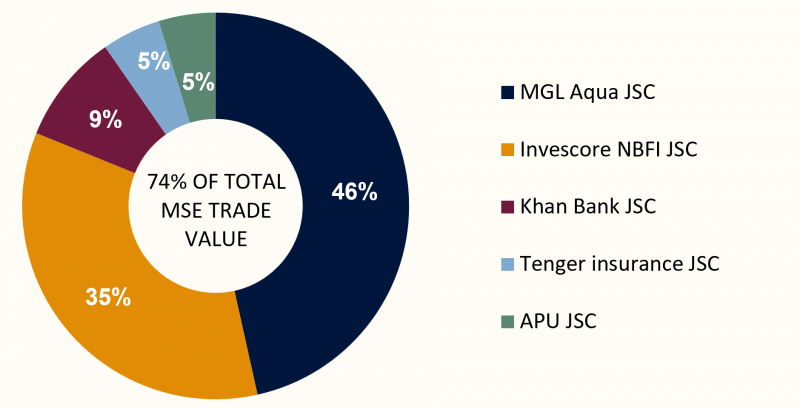
Over the course of the week, a total of 23.4 million securities with a combined value of MNT 13.8 billion were traded on the Mongolian Stock Exchange. By trading value, MGL Aqua JSC, Invescore NBFI JSC, Khan Bank JSC, Tenger insurance JSC, and APU JSC were the most actively traded securities. A total of four block trades were executed during the period, as follows:
- MGL Aqua JSC (MGLA) – 5.18 million securities at MNT 289.56 per share, totaling MNT 1.5 billion;
- MGL Aqua JSC (MGLA) – 11.14 million securities at MNT 291.19 per share, totaling MNT 3.2 billion;
- Tenger insurance JSC (TGI) – 625 thousand securities at MNT 800 per share, totaling MNT 500 million;
- Invescore NBFI JSC (INV) – 439 thousand securities at MNT 7,970 per share, totaling MNT 3.5 billion.
Last week, Mongolia’s key stock market indices recorded positive performance. The MSE B Index posted the strongest gain, rising 3.85%, followed by the MSE A Index, which increased 2.87%, and the TOP 20 Index, which gained 2.11%. Meanwhile, the FTI Index declined slightly by 0.22%, closing at 1,072.11 points. The broad-based gains across the indices suggest that investor buying interest increased across a wider range of stocks during the week. In particular, the relatively stronger performance of the MSE B Index may indicate increased trading activity among stocks included in this category. The TOP 20 Index reached 57,861.73 points, gaining 2.11%, indicating positive momentum among shares of major listed companies. In contrast, the marginal decline in the FTI Index reflects relatively subdued price movement in the fund’s unit price.
| INDEX | INDEX | INDEX |
| TOP 20 Index | 57,861.73 | +2.11% |
| MSE A Index | 22,265.54 | +2.87% |
| MSE B Index | 15,162.16 | +3.85% |
| FTI Index | 1,072.11 | -0.22% |
⇒ TAV JSC DELISTED FROM THE MONGOLIAN STOCK EXCHANGE
The shares of TAV JSC, which had been listed in the Category III of the Mongolian securities market, have been officially delisted from the Mongolian Stock Exchange (MSE).
On August 6, 2026, TAV JSC submitted an official request to the Mongolian Stock Exchange seeking to delist its securities. Accordingly, a total of 114,737 shares, each with a par value of MNT 100, were delisted pursuant to Order No. A/382 dated August 24, 2026, issued by the Acting CEO of the Mongolian Stock Exchange JSC.
⇒ COP17: MONGOLIA OPENS UP OPPORTUNITIES FOR $100 MILLION IN BLENDED FINANCE AND UP TO €200 MILLION IN FORESTRY FINANCING
The 17th Session of the Conference of the Parties to the United Nations Convention to Combat Desertification (UNCCD COP17), held in Ulaanbaatar from August 17–28, resulted in several important international financing partnerships aimed at addressing land degradation, desertification, and climate resilience in Mongolia.
The Government of Mongolia and the European Investment Bank (EIB) signed a Letter of Intent to establish a financing program of up to €200 million. Under the program, up to €20 million in European Union grants is expected to be allocated for technical and professional assistance, while up to €100 million in concessional financing from the EIB is planned to support sustainable forestry, environmental conservation, and the restoration of degraded land. The remaining financing may be mobilized from other partner institutions.
In addition, Mongolia launched the Sustainable Economic and Integrated Land Management (SMILE) program with the World Bank Group, creating an opportunity to mobilize up to $100 million in blended finance to support land conservation and restoration, as well as climate resilience.
These financing opportunities are not limited to environmental projects, but may also support local business development, green job creation, and improved livelihoods in rural communities. This could lay the groundwork for developing land restoration, forestry, and sustainable rangeland management into long-term investment opportunities.
Overall, COP17 represents an important step for Mongolia in linking the challenges of desertification and land degradation not only to environmental policy, but also to investment, financing, and local economic development. It should be noted, however, that the financing amounts mentioned above do not represent direct cash inflows into the state budget, but rather financing opportunities to be mobilized through eligible projects and programs that meet the relevant requirements.
⇒ BANK OF MONGOLIA EXPANDS INTERNATIONAL COOPERATION ON GREEN FINANCE
On August 26, the Bank of Mongolia (BoM) held meetings with international organizations participating in COP17, including the Luxembourg Sustainable Finance Initiative (LSFI), Toronto Centre, the Dutch entrepreneurial development bank (FMO), the European Bank for Reconstruction and Development (EBRD), and the Asian Development Bank (ADB). The discussions focused on sustainable and green finance policies and regulations, climate-related risk management, and financial stability.
The meetings explored opportunities to receive technical assistance from international institutions and establish knowledge- and experience-sharing partnerships to further develop Mongolia’s sustainable finance policies, transition plans, measurement and reporting frameworks, and verification mechanisms.
This demonstrates Mongolia’s efforts to develop green finance beyond simply providing “green loans” toward a more comprehensive financial ecosystem aligned with international standards, including the measurement of environmental impacts, disclosure and reporting, and third-party verification.
According to the Bank of Mongolia, as of Q1 2026, the outstanding balance of green loans in the banking sector reached MNT 2.55 trillion, accounting for 5.7% of total outstanding loans. The BoM estimates that, if the current growth momentum is maintained, the share of green loans could reach 6% by 2026 and 10% by 2030.
To further promote green financing, the Bank of Mongolia has also reduced the risk weight for green building loans to 75%, which is intended to lower banks’ capital requirements and increase their capacity to extend green loans. In addition, the maximum maturity of green consumer loans supporting environmentally friendly vehicles and household energy efficiency has been extended to 60 months.
Global equity markets recorded a generally positive but uneven performance during August 24–30. U.S. technology and AI-related stocks provided the strongest support, while European and Asian markets moved more selectively based on regional economic and policy conditions. Investors continued to weigh elevated AI valuations, inflation, Treasury yields, monetary policy, and geopolitical risks, with these factors likely to remain important drivers of global capital markets in the near term.
U.S. STOCK MARKET
- S&P 500: +0.63%
- Dow Jones: +0.56%
- Nasdaq: +1.16%
U.S. equity markets ended last week higher, with the Nasdaq rising 1.16%, the S&P 500 gaining 0.63%, and the Dow Jones advancing 0.56%. Technology and AI-related stocks remained the main drivers of market performance, with Nvidia’s quarterly results and continued demand for AI chips attracting significant investor attention. However, uncertainty surrounding the inflation outlook, Treasury yields, and the Federal Reserve’s interest-rate path continued to limit broader gains.
EUROPEAN STOCK MARKET
- FTSE 100: -0.28%
- STOXX Europe 600: +0.15%
- DAX 40: +1.83%
- CAC 40: -0.95%
European equity markets delivered mixed performance last week, with the DAX 40 rising 1.83% and the STOXX Europe 600 gaining 0.15%, while the FTSE 100 declined 0.28% and the CAC 40 fell 0.95%. German equities outperformed the broader region, although overall market performance remained uneven. Investors continued to assess the region’s economic growth outlook, inflation trends, and expectations for the European Central Bank’s monetary policy.
ASIAN STOCK MARKET
- Nikkei 225: +0.65%
- KOSPI: -1.34%
- CSI 300: -1.28%
- SSEC: +1.27%
Asian markets also moved in different directions, with the Nikkei 225 rising 0.65% and the Shanghai Composite gaining 1.27%, while the KOSPI declined 1.34% and the CSI 300 fell 1.28%. Japan’s market benefited from strength in global technology stocks, while South Korean equities remained more sensitive to movements in semiconductor and technology shares. In China, investors continued to focus on economic activity, domestic demand, and the outlook for policy support.
⇒ ️ U.S. MILITARY STRIKE RAISES RISKS AROUND THE STRAIT OF HORMUZ, PRESSURING GLOBAL MARKETS
U.S. military strike on two Iranian rocket launchers on Larak Island increased concerns over renewed escalation in the Middle East and weighed on global risk sentiment at the start of the week. According to U.S. Central Command, the launchers were being prepared by Iran’s Islamic Revolutionary Guard Corps for use in deploying sea mines in the Strait of Hormuz. Iran indicated that it would respond to the operation.
U.S. equity futures declined, with Dow Jones futures down 0.16% and S&P 500 and Nasdaq-100 futures each lower by around 0.2%. Asian markets faced greater pressure, with the KOSPI falling 3.5% and the Nikkei 225 declining 2.16%. The move reflected a more cautious approach toward risk assets amid heightened geopolitical uncertainty. In oil markets, Brent rose 2.5% to around $90.32 per barrel, while WTI gained 2.4% to approximately $85.41. Reuters reported that shipping activity through the Strait of Hormuz remained significantly below normal, increasing the potential for further oil price volatility if disruptions persist.
At the same time, expectations for U.S. monetary policy were affected by renewed concerns over inflation. Federal Reserve Chair Kevin Warsh indicated that further rate increases could be necessary if inflation does not continue moving toward the 2% target. Following his remarks, market expectations for a 25-basis-point rate hike in September reportedly increased from around 35% to 60%.
⇒ AI INVESTMENT CONTINUES TO GROW AS REGULATORY AND RETURN CONCERNS GAIN ATTENTION
AI investment continued to expand last week, but investors’ focus increasingly shifted toward returns and financing risks. At the start of the week, AI and semiconductor stocks came under pressure, with Nvidia falling 2.9%, Micron 5.8%, and Broadcom 2.6%, reflecting renewed scrutiny of elevated AI valuations and the sustainability of data-center investment.
Nvidia’s second-quarter results and forward outlook subsequently supported market sentiment, with its shares rising 6.8% and adding approximately $296 billion in market value in a single day, highlighting continued strength in demand for AI chips.
At the same time, AI infrastructure requires substantial amounts of capital. Nvidia plans to work with financial institutions to attract up to $500 billion in third-party capital for AI infrastructure, while Alibaba raised $10.2 billion through a new share issuance to finance its AI investments, highlighting concerns around equity dilution and financing costs.
From a regulatory perspective, energy consumption, infrastructure capacity, and technology security are becoming increasingly important considerations for AI data centers. This suggests that the pace of AI growth will depend not only on technology demand, but also on access to capital, energy infrastructure, and the evolving regulatory environment.