Weekly market news 12/10/2026
Weekly market news 12/10/2026

- Overview of the Mongolian Stock Exchange
- Gov’t: Export Revenue Rises, Foreign Exchange Reserves Reach a Record High
- S&P Affirms Mongolia's BB- Rating with Stable Outlook
- World economic growth to slow to 2.6% in 2026, UN trade body says
- Bank of Japan sees broadening inflationary pressure
- Overview of global stock markets
► MONGOLIAN STOCK EXCHANGE
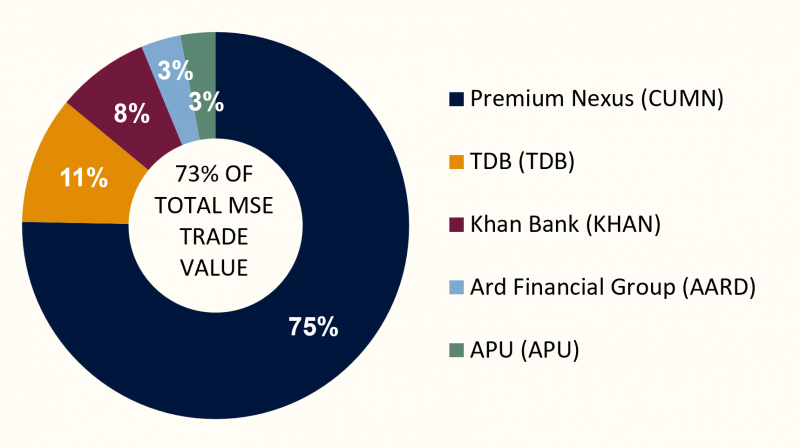
The Mongolian Stock Exchange recorded total trading value of MNT 19.12 billion during the week, with 36.7 million securities changing hands. Trading activity was concentrated in Premium Nexus (CUMN), TDB (TDB), Khan Bank (KHAN), Ard Financial Group (AARD), and APU (APU), which ranked among the most actively traded stocks by value. The market also registered one block trade during the week, reflecting continued institutional participation.
- Premium Nexus (CUMN): 30 million shares traded at MNT 350 per share, with a total transaction value of MNT 10.5 billion.
Most major indices in the Mongolian stock market closed higher last week. The MSE A Index posted the strongest performance, rising 1.54% to 26,699.43 points, while the FTI Index gained 0.35% to 1,068.53 points. The MSE B Index also increased by 0.07% to 15,354.06 points. Meanwhile, the Top 20 Index declined by 0.19% to 66,714.98 points. The broad-based gains in the indices indicate a notable increase in investor activity and buying interest in the capital market. Last week’s market growth was largely driven by gains in the banking and financial sectors.
| INDEX | POINTS | WEEKLY CHANGE |
| TOP 20 Index | 66,714.98 | -0.19% |
| MSE A Index | 26,699.43 | +1.54% |
| MSE B Index | 15,354.06 | +0.07% |
| FTI Index | 1,068.53 | +0.35% |
⇒ GOV’T: EXPORT REVENUE RISES, FOREIGN EXCHANGE RESERVES REACH A RECORD HIGH
Mongolia’s export revenue has increased 3.4 times over the past decade, reaching USD 15.7 billion in 2025. During the first nine months of 2026, export earnings rose to USD 16.6 billion, up 54% compared with the same period of the previous year. According to the Government, the export targets outlined in the 2026 State Budget have been fully achieved as of the first nine months of the year.
Looking at mining exports, copper concentrate exports have achieved 100% of the annual target, while coal exports have reached 95.7%, iron ore exports 71.8%, and crude oil exports 65% of their respective annual plans.
The increase in export revenue has boosted Mongolia’s foreign exchange reserves to USD 8.9 billion as of the end of September, setting a new all-time high. The higher reserve level has also contributed positively to the stability of the Mongolian tugrug exchange rate.
In addition, revenue from non-mining exports reached USD 776 million during the first nine months of 2026, an increase of approximately 10% compared with the same period last year. Of this amount, exports of wool and cashmere products totaled USD 244 million, up 73%year-on-year, while exports of leather and hide products reached USD 2.3 million, recording a 109% increase.
Meanwhile, exports of meat and meat products amounted to USD 84 million, representing an 11% decline compared with the same period of the previous year.
⇒ S&P AFFIRMS MONGOLIA'S BB- RATING WITH STABLE OUTLOOK
S&P Global Ratings has reaffirmed Mongolia’s sovereign credit rating at BB- with a Stable Outlook, reflecting confidence in the country’s mining-led growth, fiscal stability, and manageable public debt levels.
Mining remains the key growth engine. S&P expects Mongolia’s economy to grow by an average of 5.6% annually through 2029, supported by increasing copper production at Oyu Tolgoi and rising coal exports to China. Coal export volumes are projected to reach 100 million tonnes in 2026, up from 84 million tonnes in 2025, while copper is becoming an increasingly important source of export revenue.
Fiscal fundamentals remain strong. The ratings agency forecasts budget surpluses of 2.0% of GDP in 2026 and 1.6% in 2027, driven by robust mining revenues. Government debt is expected to remain stable at around 25% of GDP, although higher spending on infrastructure and strategic projects could pose risks over time.
External indicators continue to improve. Strong mineral exports are expected to narrow the current account deficit to around 1% of GDP in 2026, from 8% in 2025, while external debt ratios continue to decline. However, Mongolia remains exposed to commodity price swings and economic conditions in China, its largest trading partner.
For investors, the rating affirmation highlights Mongolia’s improving macroeconomic outlook, supported by expanding mining production, strengthening external balances, and continued fiscal discipline. While commodity dependence and policy uncertainty remain key risks, the Stable Outlook suggests confidence in the country's near-term economic trajectory.
Global markets were driven by the interplay of interest-rate expectations, AI-sector volatility, easing geopolitical risks, and concerns about China's economic recovery. While these factors created short-term volatility, investors generally remained optimistic about the global growth outlook.
U.S. STOCK MARKET
- S&P 500: +1.04%
- Dow Jones: +0.89%
- Nasdaq: +0.52%
The US market finished the week higher, with the S&P 500 reaching another near-record close. Gains were supported by continued economic resilience and easing Treasury yields after yields briefly hit their highest levels since 2002 early in the week. Defensive sectors such as utilities and consumer staples outperformed, while technology shares faced temporary pressure following concerns about the sustainability of AI-related spending after reports regarding OpenAI's revenue outlook weighed on semiconductor stocks. Despite the mid-week sell-off in chipmakers, investors ultimately maintained confidence in corporate earnings and economic growth.
EUROPEAN STOCK MARKET
- FTSE 100: +0.86%
- STOXX Europe 600: -0.34%
- DAX 40: -0.65%
- CAC 40: -0.57%
European markets were mixed. The FTSE 100 benefited from gains in mining and technology shares, while falling oil prices and lower bond yields improved risk appetite. However, Germany's DAX and France's CAC 40 declined over the week as investors remained concerned about growth prospects, elevated yields earlier in the week, and global technology-sector weakness. Sentiment improved on Friday after signs of easing geopolitical tensions in the Middle East helped trigger a broad rebound across European equities.
ASIAN STOCK MARKET
- Nikkei 225: -0.12%
- KOSPI: -5.94%
- CSI 300: -0.87%
- SSEC: -0.66%
Asian markets showed divergent performance. South Korea's KOSPI suffered the region's sharpest decline, largely due to weakness in semiconductor shares and profit-taking after a strong rally earlier in the year. Chinese equities remained under pressure as concerns over domestic economic momentum, property-sector challenges, and subdued investor confidence outweighed policy support measures, resulting in declines for both the CSI 300 and Shanghai Composite.
⇒ ️ WORLD ECONOMIC GROWTH TO SLOW TO 2.6% IN 2026, UN TRADE BODY SAYS
The United Nations Conference on Trade and Development (UNCTAD) expects global economic growth to slow to 2.6% in 2026, down from 2.9% in 2025, as the energy shock stemming from tensions in the Middle East weighs on the global economy. Despite the weaker growth outlook, global trade in goods and services is projected to expand by 4%, following a record USD 35 trillion in global trade last year. However, much of this increase is expected to be driven by higher energy prices rather than stronger underlying demand.
Global trade patterns continue to evolve amid rising geopolitical and economic fragmentation. Trade between the United States and China has fallen by more than 20% since 2024, while East Asian economies have strengthened trade links with both China and North America. UNCTAD notes that export controls, investment screening measures, and supply-chain requirements are making it more difficult for new entrants to participate in strategic industries.
Asia is expected to remain the primary engine of global growth, contributing 59% of worldwide economic expansion in 2026. Growth is forecast at 7.3% in India, 4.5% in China, and 5.2% in Indonesia, highlighting the region's continued importance to the global economy.
UNCTAD also highlighted the growing role of artificial intelligence-related industries, particularly semiconductors, in driving merchandise trade. However, the agency cautioned that increased AI-related trade does not necessarily translate into broad-based economic development. It also warned that the rapid concentration of investment in a small number of AI-related companies could create potential financial stability risks.
Meanwhile, international institutions remain cautious on the global outlook. The World Bank recently lowered its 2026 global growth forecast to 2.5%, citing the impact of the Middle East conflict, while the International Monetary Fund expects growth of 3.0% but continues to identify geopolitical tensions, trade fragmentation, and potential AI-related market corrections as key downside risks.
⇒ BANK OF JAPAN SEES BROADENING INFLATIONARY PRESSURE
The Bank of Japan (BOJ) indicated that inflationary pressures are becoming more widespread across the economy, as rising raw material, energy, and labour costs increasingly feed through to consumer prices. The central bank noted that more companies are raising prices more frequently than in the past, suggesting that inflation is no longer confined to a limited number of sectors and is becoming more entrenched. This assessment has reinforced market expectations that the BOJ could raise interest rates again later this year.
At the same time, the BOJ remains optimistic about Japan’s economic outlook. Strong demand linked to artificial intelligence is supporting production and investment across a range of industries, including electronics, machinery, telecommunications infrastructure, and data centres. Corporate investment appetite remains robust, driven by digitalisation initiatives and AI-related expansion, while the economic impact of the Middle East conflict appears to be easing in several regions.
Regional BOJ officials highlighted that businesses are increasingly passing higher costs on to consumers, reflecting persistent upward pressure from elevated energy prices, a weaker yen, rising labour costs, and higher semiconductor prices associated with the global AI boom. These trends suggest inflation may remain above historical norms for some time.
Japan’s economy continues to benefit from strong AI-related investment and resilient corporate spending, but broadening inflationary pressures are strengthening the case for further monetary policy tightening. Markets will closely watch the BOJ’s 29-30 October policy meeting and updated economic forecasts for signals on the timing of the next interest rate increase.