Weekly market news 09/11/2026
Weekly market news 09/11/2026

- Overview of the Mongolian Stock Exchange
- Erdenes Tavan Tolgoi JSC receives an unqualified opinion from an international audit firm
- Diesel fuel prices nearly double within a year
- Invescore NBFI JSC completes 1-for-10 stock split, trading resumes
- Canada's economic activity gains momentum as employment improves in October
- IMF's Georgieva urges Central Banks to monitor ai growth risks
- Overview of global stock markets
► MONGOLIAN STOCK EXCHANGE
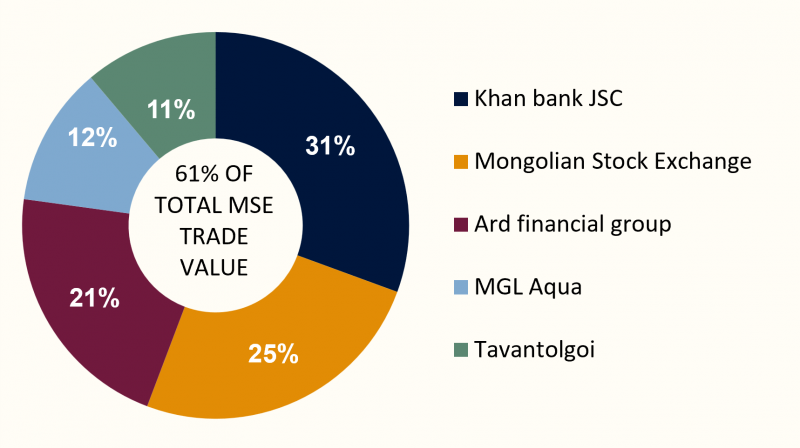
The Mongolian Stock Exchange recorded total trading value of MNT 4 billion during the week, with 7.6 million securities changing hands. Trading activity was concentrated in Khan bank, Mongolian Stock Exchange, Ard financial group, MGL Aqua, and Tavan tolgoi, which ranked among the most actively traded stocks by value. The market also registered two block trades during the week, reflecting continued institutional participation.
- Mongolian Stock Exchange (MSE): 1.1 million shares traded at MNT 439.19 per share, with a total transaction value of MNT 500 million.
- MGL Aqua (MGLA): 1 million shares traded at MNT 269.09 per share, with a total transaction value of MNT 283.6 million.
Last week, the domestic stock market saw mixed movements. The TOP-20 Index closed higher, while the MSE A, MSE B and FTI indices declined. Shares of large-cap companies supported the index, but selling pressure prevailed among mid- and small-cap stocks. The FTI Index, which is based on foreign markets, fell sharply amid a steep correction in global equity markets.
The TOP-20 Index rose 0.43% week-on-week to 67,843.10 points. This shows that, even in a risk-averse environment, investors continue to favor liquid shares of leading companies. Meanwhile, the MSE A Index edged down 0.10% to 25,268.96 points, and the MSE B Index fell 0.68% to 15,084.85 points. Both declines point to weak demand for mid- and small-cap stocks.
The FTI Index posted the week’s largest decline, falling 8.02% to 954.13 points. Half of the FTI portfolio is made up of technology and artificial intelligence companies, and 10% is energy companies. As a result, the sell-off in technology stocks on the US stock market and the drop in oil prices weighed directly on the index. During the week, concerns grew that AI-sector regulation could tighten following the results of the US midterm elections.
| INDEX | POINTS | WEEKLY CHANGE |
| TOP 20 Index | 67,843.10 | +0.43% |
| MSE A Index | 25,268.96 | -0.10% |
| MSE B Index | 15,084.85 | -0.68% |
| FTI Index | 954.13 | -8.02% |
⇒ ERDENES TAVAN TOLGOI JSC RECEIVES AN UNQUALIFIED OPINION FROM AN INTERNATIONAL AUDIT FIRM
Within the framework of a decision by the Government of Mongolia, Erdenes Tavan Tolgoi JSC has undergone an independent external audit of its operations over the past three years by the international audit firm BDO and has received the corresponding audit reports and conclusions.
As a result of the audit, BDO concluded that the company’s financial statements comply with the requirements of International Financial Reporting Standards (IFRS) and International Accounting Standards (IAS), and therefore issued an unqualified opinion, which represents a positive audit conclusion.
This conclusion marks an important milestone in the company’s preparations for an international valuation, stock exchange listing, and eventual transition to the status of a publicly traded company. During the audit process, the company provided all necessary information and explanations in full, while both parties held regular management-level meetings and strictly adhered to the principles of auditor independence.
Under the terms of the agreement, BDO conducted audits of the company’s financial statements in accordance with international standards and fully completed its recommendations and additional assignments. As a result, both parties concluded that the objectives of their cooperation had been successfully achieved.
The audited financial statements and related information were prepared in compliance with international requirements, creating a solid foundation for providing accurate and reliable information to domestic and international investors, shareholders, and other stakeholders. Accordingly, the parties formally signed and confirmed the implementation of their memorandum of cooperation.
⇒ DIESEL FUEL PRICES NEARLY DOUBLE WITHIN A YEAR
Over the past year, diesel fuel prices have increased by 89.1%, bringing the price per liter to MNT 5,700. Meanwhile, the price of AI-92 gasoline rose by 38.7%, reaching MNT 3,592 per liter.
Specifically, diesel fuel was priced at MNT 3,014 per liter in early November last year. As of the same period this year, the price had increased by MNT 2,686 per liter. In comparison, AI-92 gasoline was selling for MNT 2,590 per liter a year ago and has since risen by MNT 1,002 per liter.
During the past month alone, diesel fuel prices climbed by 14.2%, while AI-92 gasoline prices increased by 4.2%. However, prices for both fuel types remained unchanged over the most recent week.
⇒ INVESCORE NBFI JSC COMPLETES 1-FOR-10 STOCK SPLIT, TRADING RESUMES
The Mongolian Stock Exchange resumed trading in shares of Invescore NBFI JSC on November 6, 2026, following an amendment to the company’s securities registration.
The company carried out a 10-for-1 stock split under Resolution No. 450 of the Financial Regulatory Commission, dated October 22, 2026. As a result, its 75,744,281 common shares with a par value of MNT 227 each became 757,442,810 common shares with a par value of MNT 22.7 each. The Central Securities Depository LLC has recorded the change in the securities register.
A stock split does not change the total par value of a company’s shares. Each shareholder’s number of shares increases tenfold, while the par value per share falls by a factor of ten. A split of this kind typically lowers the unit share price, making the stock more accessible to retail investors and supporting trading activity.
Global markets were pressured by concerns over the sustainability of the AI investment boom, political uncertainty surrounding U.S. technology regulation, and stronger-than-expected U.S. labor data, which reinforced expectations of prolonged tight monetary policy. Investors rotated out of technology stocks and into defensive assets, driving broad market volatility. As a result, the Nasdaq was the weakest-performing major U.S. index, falling 3.99% for the week, while the Dow Jones proved the most resilient, declining 1.39%.
U.S. STOCK MARKET
- S&P 500: -3.07%
- Dow Jones: -1.39%
- Nasdaq: -3.99%
U.S. markets were primarily driven by a sharp reassessment of the AI investment theme. Technology and semiconductor stocks came under pressure as investors questioned whether the massive spending on AI infrastructure and data centers would generate sufficient returns. This led to a significant selloff in AI-related shares, weighing heavily on the Nasdaq and S&P 500.
Political developments also influenced sentiment. Investors evaluated the implications of the U.S. midterm election results, particularly the prospect of tighter regulation of artificial intelligence and large technology companies.
EUROPEAN STOCK MARKET
- FTSE 100: -0.85%
- STOXX Europe 600: +0.43%
- DAX 40: +0.07%
- CAC 40: +2.26%
European equities largely followed the direction of Wall Street. The global technology-led selloff reduced risk appetite across European markets, particularly for growth-oriented sectors.
At the same time, rising U.S. Treasury yields increased concerns that global borrowing costs could remain elevated. Export-oriented markets such as Germany's DAX were particularly sensitive to weaker global growth expectations and slower technology-sector momentum.
ASIAN STOCK MARKET
- Nikkei 225: -8.79%
- KOSPI: -10.25%
- CSI 300: +1.21%
- SSEC: +0.96%
Asian markets reacted differently depending on their sector composition.
Japan's Nikkei 225 and South Korea's KOSPI were pressured by weakness in semiconductor and technology stocks, reflecting concerns seen in the U.S. AI sector. Technology-heavy companies faced selling pressure as investors reassessed earnings expectations and infrastructure spending trends globally.
Chinese markets, including the CSI 300 and Shanghai Composite (SSEC), were relatively more resilient. Investor sentiment was supported by expectations of domestic policy support and accommodative liquidity conditions, although gains were limited by global market volatility and uncertainty surrounding external demand.
⇒ ️ CANADA'S ECONOMIC ACTIVITY GAINS MOMENTUM AS EMPLOYMENT IMPROVES IN OCTOBER
Canada’s economy expanded at a slightly faster pace in October, supported by stronger hiring activity, according to the latest Ivey Purchasing Managers Index (PMI) data.
The seasonally adjusted Ivey PMI edged up to 58.3 in October from 58.2 in September, indicating continued growth in economic activity. A reading above the 50-point threshold signals expansion, based on monthly responses from purchasing managers across the country.
Employment conditions showed further improvement during the month, with the adjusted employment index climbing to 58.3 from 56.5 in September. Meanwhile, the adjusted prices index eased slightly to 81.7 from 82.8, suggesting a modest slowdown in price pressures.
In contrast, the unadjusted PMI declined to 56.4 in October, down from 61.9 recorded a month earlier.
⇒ IMF'S GEORGIEVA URGES CENTRAL BANKS TO MONITOR AI GROWTH RISKS
IMF Managing Director Kristalina Georgieva said central banks should consider any slowdown in AI-driven growth as they calibrate measures to contain inflation.
Speaking in Washington, Georgieva said concerns over the sustainability of the AI investment boom and elevated asset valuations have increased market volatility, complicating efforts to maintain price stability.
She noted that while AI-related investment has supported economic growth and helped offset some external shocks, it has also contributed to inflationary pressures and financial stability risks.
Georgieva added that any weakening in the growth impulse generated by artificial intelligence would be an important factor for policymakers as they determine the next steps in their fight against persistent inflation.