Weekly market news 03/08/2026
Weekly market news 03/08/2026

- Overview of the Mongolian Stock Exchange.
- The total value of securities traded reached MNT 865.6 billion, doubling compared with the same period last year.
- Innovation Investment JSC announced a dividend distribution from its retained earnings.
- The Mongolian Association of Securities Dealers (MASD) participated in the "Market Opportunities for Foreign Banks in Mongolia" event.
- Oil prices remained volatile amid ongoing geopolitical risks.
- The Federal Reserve kept interest rates unchanged and maintained a cautious stance on inflation.
- Overview of global stock markets.
► MONGOLIAN STOCK EXCHANGE
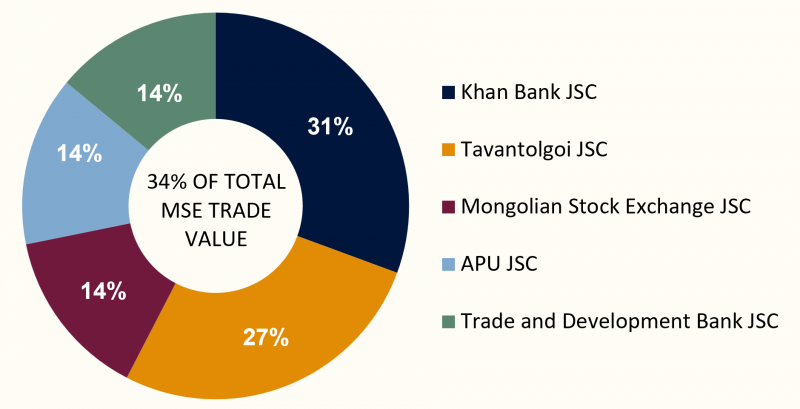
Over the course of the week, a total of 4.5 million securities with a combined value of MNT 3.7 billion were traded on the Mongolian Stock Exchange. By trading value, the most actively traded securities were Khan Bank JSC, Tavantolgoi JSC, Mongolian Stock Exchange JSC, APU JSC, and Trade and Development Bank of Mongolia. No block trades were executed during the period.
The Mongolian Stock Exchange indices closed mostly higher during the week, reflecting broad-based gains across the equity market. The TOP-20 Index advanced 2.85% to 54,126.05, while the MSE A Index rose 2.50% to 20,800.63. The MSE B Index also gained 1.52%, ending at 14,402.83. In contrast, the FTI edged down 0.38% to 1,011.38.
Buying interest was broad-based, with both large-cap and smaller-cap equities posting gains, indicating improved investor sentiment across the market. The slight decline in the FTI suggests modest weakness in investment fund units, while the overall market remained supported by strong demand for listed equities.
| INDEX | POINTS | WEEKLY CHANGE |
| TOP 20 Index | 54,126.05 | +2.85% |
| MSE A Index | 20,800.63 | +2.50% |
| MSE B Index | 14,402.83 | +1.52% |
| FTI Index | 1,011.38 | -0.38% |
⇒ SECURITIES MARKET TURNOVER DOUBLES, LED BY PRIMARY MARKET ACTIVITY
In the first half of 2026, the total value of transactions in Mongolia’s securities market reached MNT 865.6 billion, an increase of MNT 435.4 billion, or approximately twofold, compared with the same period last year. Primary market activity was the main driver of this growth, accounting for 66.0% of total transactions, or MNT 570.9 billion, while secondary market transactions totaled MNT 294.7 billion, representing the remaining 34.0%.
• Total securities transactions: MNT 865.6 billion (2.0x increase)
• Primary market: MNT 570.9 billion (66.0% of total transactions)
• Secondary market: MNT 294.7 billion (34.0% of total transactions)
• Market capitalization: MNT 13.7 trillion (+12.8%)
• TOP-20 Index monthly average: 51,621.47 points (+2,896.34 points year-on-year)
Despite the sharp increase in transaction value, the number of securities traded declined by 57.9% year-on-year to 266.3 million securities. This indicates that market growth was driven by fewer but higher-value transactions, particularly corporate bond issuances and primary market financing.
Corporate bonds accounted for the largest share of total securities transactions at 53.5%, followed by equities at 16.2%, asset-backed securities at 15.4%, and government bonds at 14.8%. The composition of trading activity highlights the growing importance of debt instruments as a source of financing in Mongolia’s capital market.
⇒ INNOVATION INVESTMENT JSC TO DISTRIBUTE DIVIDENDS FROM RETAINED EARNINGS
The Board of Directors of Innovation Investment JSC, pursuant to Resolution No. BOD-26/26 dated July 29, 2026, has approved the distribution of dividends from the Company's retained earnings. The Company will distribute a total of MNT 11.09 billion in cash dividends to holders of its 184.9 million common shares, equivalent to MNT 60 per share.
Shareholders entitled to receive the dividend will be determined based on the record date of August 14, 2026. The cash dividend will be credited to shareholders' accounts through the Mongolian Central Securities Depository (MCSD) no later than August 26, 2026.
• Total dividend: MNT 11.09 billion
• Dividend per share: MNT 60
• Total outstanding shares: 184,889,160 common shares
• Record date: August 14, 2026
• Dividend payment date: No later than August 26, 2026
• Payment method: Cash
⇒ MASD PARTICIPATES IN THE "MARKET OPPORTUNITIES FOR FOREIGN BANKS IN MONGOLIA" EVENT
Mr. G. Enkhbat, Chairman of the Board of the Mongolian Association of Securities Dealers (MASD), participated in the "Market Opportunities for Foreign Banks in Mongolia" event organized by the Embassy of Mongolia in the Republic of Korea. During the event, he presented investment opportunities in Mongolia's banking and financial sectors, outlined the proposed amendments to the Banking Law, and highlighted opportunities for foreign investors to access Mongolia's capital market in addition to the banking sector.
- Main topic: Investment opportunities in Mongolia's banking and financial sectors
- Proposed legal amendments: Increase in the maximum ownership limit from 20% to 34%, and the threshold for a significant shareholder from 5% to 10%
- Key opportunities: Acquisition of bank shares, establishment of bank branches or subsidiaries, and the establishment of investment banks.
Global equity markets delivered mixed performance during the week of July 27–31, 2026. U.S. and European markets were supported by strong corporate earnings, resilient economic data, and broadly stable monetary policy expectations. In contrast, Asian markets weakened as investors reduced exposure to technology stocks amid growing concerns over AI-related spending and elevated valuations. Meanwhile, ongoing geopolitical tensions in the Middle East and continued volatility in oil prices remained key macroeconomic risks, keeping investors focused on inflation trends, central bank policy, and the broader outlook for global economic growth.
U.S. STOCK MARKET
- S&P 500:+0.34%
- Dow Jones: +0.60%
- Nasdaq: +0.55%
U.S. equities posted modest gains during the week as investors focused on the Federal Reserve's July policy meeting, second-quarter GDP data, and earnings from major technology companies. The Fed kept interest rates unchanged while maintaining a cautious stance on inflation, reinforcing expectations that monetary policy will remain data-dependent. Strong earnings from companies such as Microsoft supported market sentiment, although concerns over the profitability of large-scale AI investments continued to weigh on parts of the technology sector. Overall, resilient corporate earnings and solid economic fundamentals helped offset pressure from higher Treasury yields.
EUROPEAN STOCK MARKET
- FTSE 100: +0.80%
- STOXX Europe 600: +0.50%
- DAX 40 (Герман): +0.67%
- CAC 40 (Франц): +0.79%
European equities finished the week higher, supported by stronger-than-expected corporate earnings and resilient economic data. The STOXX Europe 600 approached record levels as gains in financials, industrials, and energy stocks outweighed weakness in selected technology names. Investors also monitored inflation data and the European Central Bank's policy outlook, while easing concerns over energy supply disruptions provided additional support to market sentiment.
ASIAN STOCK MARKET
- Nikkei 225: -1.23%
- KOSPI: -3.10%
- CSI 300: -2.43%
- SSEC : -0.67%
Asian equity markets ended the week lower, reflecting weaker sentiment across the region. Technology and semiconductor stocks came under pressure as investors reassessed elevated valuations and the returns on AI-related capital spending. South Korea's market led regional declines amid heavy selling in chipmakers, while Japan's equities were weighed down by weakness in semiconductor shares despite a relatively stable domestic economic outlook. In China, expectations of additional policy support helped limit losses, but concerns over economic growth and global trade continued to restrain investor confidence.
⇒ ️ OIL PRICES REMAIN VOLATILE AS MARKETS MONITOR GEOPOLITICAL RISKS
Global oil markets remained highly volatile as geopolitical tensions in the Middle East persisted. During the final week of July, reports suggesting progress in diplomatic discussions between the United States and Iran, along with indications that the U.S. had temporarily delayed military action, triggered a sharp decline in oil prices. However, with regional security risks still unresolved, investors have maintained a cautious stance.
• Brent crude: Approximately USD 89.45 per barrel
• WTI crude: Approximately USD 83–84 per barrel
• Key market drivers: U.S.–Iran relations and shipping risks in the Red Sea and the Strait of Hormuz
• Market outlook: Supply disruption concerns have eased, but geopolitical uncertainty remains elevated
Last week, investors became increasingly optimistic about the prospects for a diplomatic resolution between the United States and Iran, leading to a partial unwinding of the geopolitical risk premium that had been built into oil prices. At the same time, Saudi Arabia's initiative to strengthen maritime security in the Red Sea helped alleviate some concerns over potential supply disruptions by improving confidence in regional shipping routes.
Nevertheless, uncertainty has not fully subsided. Shipping through the Strait of Hormuz has yet to return completely to normal, while ongoing threats to commercial vessels and the continued risk of attacks by Yemen's Houthi forces continue to pose challenges to the stability of global oil supplies. As a result, oil prices remain highly sensitive to geopolitical developments and the progress of diplomatic negotiations.
From a capital markets perspective, the decline in oil prices below USD 100 per barrel provides some relief for global inflation expectations, potentially easing pressure on central banks to maintain restrictive monetary policies. However, any renewed escalation in geopolitical tensions could quickly drive energy prices higher again, leaving investors closely focused on geopolitical risks rather than underlying oil market fundamentals.
⇒ FEDERAL RESERVE HOLDS INTEREST RATES STEADY, MAINTAINS A CAUTIOUS STANCE ON INFLATION
The U.S. Federal Reserve (Fed) decided to keep its policy interest rate unchanged at 3.50%–3.75% at its July monetary policy meeting. While the decision was widely expected by markets, the 9–3 vote revealed a growing divergence of views within the Federal Open Market Committee (FOMC), with three members voting in favor of a 25-basis-point rate increase, reflecting continued concerns over persistent inflation.
In its policy statement, the Fed emphasized that the U.S. economy continues to demonstrate resilience despite ongoing geopolitical uncertainty in the Middle East. Labor market conditions remain strong, with employment growth broadly keeping pace with labor force expansion and the unemployment rate remaining largely unchanged. Investment activity and productivity also continue to perform well, underscoring the economy's solid underlying fundamentals. At the same time, the Fed reiterated that inflation remains above its 2% target, largely due to higher energy prices and other supply-side factors, and reaffirmed that restoring price stability remains its primary policy objective.
Fed Chair Kevin Warsh refrained from providing explicit forward guidance on future policy decisions, emphasizing that the central bank will continue to adopt a data-dependent approach. Following the meeting, yields on long-term U.S. Treasury securities moved higher as investors reassessed the likelihood of another interest rate increase later this year. From a capital markets perspective, while the decision to leave rates unchanged provides short-term stability in financial conditions, the divided vote within the Fed and persistent inflationary pressures have reinforced expectations that higher interest rates could remain in place for longer.