Weekly market news 07/27/2026
Weekly market news 07/27/2026

- Overview of the Mongolian Stock Exchange.
- Хac Bank JSC to Resume Its Share Repurchase Program.
- Mongolia's Foreign Trade Continues to Expand.
- Government Securities Auctions Continue.
- Oil Prices Rise as Markets Monitor Geopolitical Risks.
- Investor Concerns Grow Over the Returns on AI Investment.
- Overview of global stock markets.
► MONGOLIAN STOCK EXCHANGE
Over the course of the week, a total of 4.7million securities with a combined value of MNT 10.8 billion were traded on the Mongolian Stock Exchange. By trading value, BDSEC JSC, InvesCore NBFI JSC, Ard Financial Group JSC, Khan Bank JSC, and Golomt Bank JSC were the most actively traded securities during the week. A total of four block trades were executed during the period, including:
- BDSEC JSC (BDS): 325,464 shares traded at MNT 1,266 per share, with a total transaction value of MNT 412.0 million;
- InvesCore NBFI JSC (INV): 39,225 shares traded at MNT 7,650 per share, with a total transaction value of MNT 300.1 million;
- InvesCore NBFI JSC (INV): 84,510 shares traded at MNT 10,650 per share, with a total transaction value of MNT 900.0 million;
- Ard Financial Group JSC (AARD): 193,814 shares traded at MNT 3,000 per share, with a total transaction value of MNT 581.4 million.
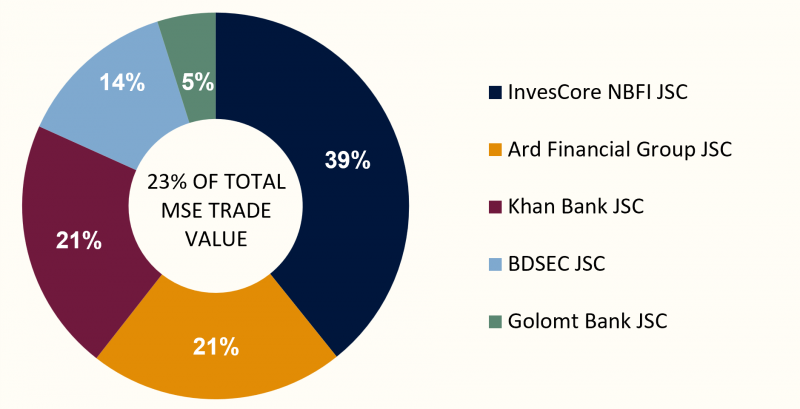
The Mongolian Stock Exchange indices closed with mixed performance during the week. The TOP-20 Index rose by 2.02%, while the MSE A Index gained 1.43%. In contrast, the MSE B Index declined by 0.73%, and the FTI Index edged down 0.51%.
Buying interest remained relatively strong in large-cap and market-leading companies, supporting gains in the broader market. Meanwhile, increased selling pressure weighed on small- and mid-cap stocks, resulting in mixed price movements across the market. The FTI Index also fell by 0.51%, indicating a modest decline in the value of investment fund units.
| INDEX | POINTS | WEEKLY CHANGE |
| TOP 20 Index | 52,625.64 | +2.02% |
| MSE A Index | 20,293.45 | +1.43% |
| MSE B Index | 14,186.75 | -0.73% |
| FTI Index | 1,015.27 | -0.51% |
⇒ XACBANK TO RESUME ITS SHARE REPURCHASE PROGRAM
XacBank has announced that it will resume its share repurchase program to enhance the liquidity of its shares for minority shareholders. The program was originally launched in 2024 and, following approval from the Bank of Mongolia and a resolution of the Board of Directors, will continue for another 12 months beginning July 23, 2026.
The share repurchases will be conducted through the Mongolian Stock Exchange via open market transactions. The Bank plans to repurchase up to 7.5 million shares at a price not exceeding MNT 1,200 per share. The total budget allocated for the program is up to MNT 9.0 billion, and the authorization will remain effective until July 22, 2027.
The program may be terminated before its scheduled expiry if the maximum number of shares has been repurchased or if the allocated funding has been fully utilized.
⇒ MONGOLIA'S FOREIGN TRADE CONTINUES TO EXPAND
Mongolia's total foreign trade reached USD 17.6 billion during the first 6.5 months of 2026, representing a 35.9% increase compared with the same period last year. Exports rose by 57.5%, while imports increased by 10.5%. As a result, the country recorded a trade surplus of USD 4.5 billion, more than 4.2 times higher than a year earlier.
Copper ore and concentrates remained Mongolia's largest export, with export value reaching USD 4.9 billion, up 93% year-on-year. Coal exports totaled USD 4.2 billion, an increase of 57%, while exports of combed cashmere nearly doubled to USD 124.8 million. Although the value of gold exports remained broadly stable, export volumes declined during the period.
On the import side, diesel fuel imports increased to USD 976.9 million (+50.5%), while gasoline imports rose to USD 376.0 million (+23.0%). In contrast, passenger vehicle imports declined to USD 553.8 million, down 22.6% from the same period last year.
Strong growth in mining exports—particularly copper, coal, and cashmere—lifted Mongolia's trade surplus to a record high. Meanwhile, import growth was driven primarily by higher fuel imports, while declines in passenger vehicle and rice imports suggest softer demand across certain consumer categories.
⇒ GOVERNMENT SECURITIES AUCTIONS CONTINUE
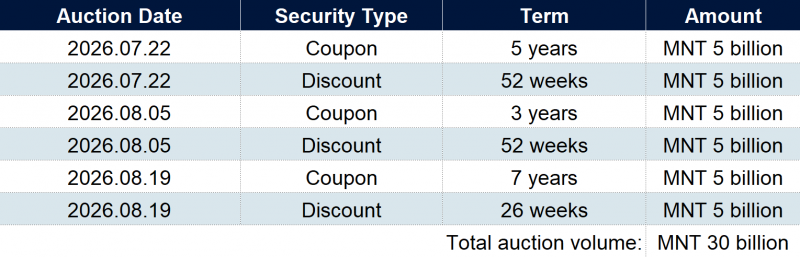
At the July 22, 2026 primary market auction, the Government of Mongolia successfully issued 5-year coupon-bearing government securities and 52-week discount Treasury bills. Following the completion of the primary offering, the securities entered secondary market trading. Investors may continue to participate in the remaining government securities auctions through MICC.
Government securities auction schedule, July 22 – August 19, 2026:
Between July 20–24, global markets were driven by oil prices rising above $100 a barrel amid the escalating U.S.-Iran conflict, and by growing investor concern over AI spending following Alphabet and Tesla's earnings. Markets recovered midweek before falling sharply on Thursday. The decline extended into Friday in Asian markets, while U.S. and European stocks stabilized or rebounded.
U.S. STOCK MARKET
- S&P 500: -0.61%
- Dow Jones: -0.38%
- Nasdaq: -2.13%
U.S. stocks moved unevenly through the week. Prices fell slightly on Monday as oil prices rose. On Tuesday, semiconductor stocks rallied and lifted all three indexes higher. On Wednesday, the S&P 500 and Dow were little changed, while the Nasdaq fell as oil prices reached a one-month high. On Thursday, Alphabet's higher spending plans and Tesla's profit miss led to a sharp drop in technology stocks, with the Nasdaq falling 2.15% in a single day. Stocks stabilized on Friday, with the Dow and S&P 500 recovering slightly while the Nasdaq slipped further.
EUROPEAN STOCK MARKET
- FTSE 100: +1.28%
- STOXX Europe 600: +0.46%
- DAX 40 (Герман): +1.08%
- CAC 40 (Франц): +0.40%
European markets were mostly steady to higher for most of the week, then fell on Thursday. Stocks were little changed on Monday as investors watched rising oil prices and diplomatic developments in the Middle East. On Tuesday, gains in technology and mining shares lifted markets, even as oil prices rose further following fresh U.S. strikes on Iran. Markets rose again on Wednesday, reaching a two-week high, led by energy and defense stocks, while technology stocks dipped slightly ahead of Alphabet and Tesla's earnings reports in the U.S. On Thursday, the sell-off in U.S. technology stocks following those earnings spread to Europe, and markets fell for the day.
ASIAN STOCK MARKET
- Nikkei 225: +0.97%
- KOSPI: -1.90%
- CSI 300: +2.61%
- SSEC :+1.33%
Asian markets were mixed through the week. Japan's stock market was closed on Monday for a public holiday. When Tokyo reopened on Tuesday, the Nikkei rose 3.26% and South Korea's KOSPI also rebounded sharply, as investors bought back shares that had fallen during the previous week. On Wednesday, most other Asian markets advanced, tracking Tuesday's gains on Wall Street, while Japan's Nikkei gave back its early gains to close slightly lower. On Thursday, Japan's Nikkei rose 0.46% as investors bought back semiconductor and AI-related shares, and South Korea's KOSPI rose 4.4%. On Friday, Asian markets fell broadly, following Wall Street's sharp overnight decline and oil prices rising above $100 per barrel; South Korea's KOSPI fell more than 5%, and Japan's Nikkei fell more than 2%.
⇒ ️ OIL PRICE PASSES $100 A BARREL AS U.S.-IRAN CONFLICT ESCALATES
On July 23, Brent crude oil jumped about 7% to around $100 per barrel, its highest level since May 22. This followed reports that Yemen's Houthi group attacked two Saudi Arabian oil tankers in the Red Sea, and President Trump's comments that he was "considering a massive attack" on Iran.
Supply concerns were added to by Kazakhstan's decision to halt crude oil exports through the Caspian Pipeline Consortium terminal following drone attacks.
Oil prices had been rising more gradually earlier in the week, from about $87 on Monday to $94 on Wednesday, as the U.S. carried out repeated strikes on Iran and ceasefire talks stalled.
Last month's inflation report showed lower prices mainly because gasoline had become cheaper during an earlier ceasefire period. With oil prices rising again, there is a risk that July's inflation numbers could increase instead of continuing to fall.
U.S. government bond yields also rose to their highest levels this year. The 10-year yield reached 4.66%, and the 30-year yield stayed above 5% for a 27th straight trading day, the longest such period since 2007.
Some Federal Reserve officials, including Governor Christopher Waller, said that if energy prices keep pushing inflation higher, the Fed may need to raise interest rates instead of cutting them as previously expected.
⇒ CONCERNS GROW OVER AI SPENDING AFTER ALPHABET AND TESLA EARNINGS
Alphabet and Tesla released second-quarter earnings after markets closed on July 22. Alphabet's results beat expectations, but the company raised its 2026 spending plans for AI infrastructure to between $195 billion and $205 billion, up from its earlier estimate of $180 billion to $190 billion.
Tesla reported lower profit than expected, even though the company had strong vehicle deliveries during the quarter. Both companies reported negative free cash flow for the quarter.
Investors reacted the next day, July 23, by selling shares in both companies. Alphabet fell about 6.5% and Tesla fell 14%. Other large technology companies planning heavy AI spending, including Meta, Microsoft, and Amazon, also declined. The Nasdaq Composite fell 2.15% that day.
The sell-off reflects a wider question among investors: whether the large amounts of money technology companies are spending on AI will produce enough profit to justify the cost. A measure of the largest U.S. megacap stocks had its worst trading day since April 2025, when markets fell sharply due to new tariffs.