Weekly market news 07/20/2026
Weekly market news 07/20/2026

- Overview of the Mongolian Stock Exchange.
- The securities listing of "Erdene Resource Development Corporation" was amended again.
- KakaoBank and MCS Group signed a term sheet document for investment.
- The Government's primary and secondary market auctions of domestic securities were held successfully.
- The US Consumer Price Index report was released.
- Concerns grew over the sustainability of AI-related investment growth.
- Overview of global stock markets.
► MONGOLIAN STOCK EXCHANGE
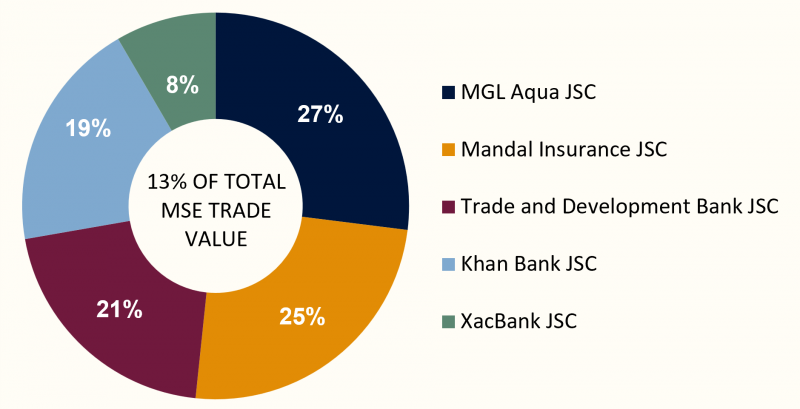
Over the course of the week, a total of 10.3 million securities with a combined value of MNT 4.7 billion were traded on the Mongolian Stock Exchange. In terms of trading value, MGL Aqua JSC, Mandal Insurance JSC, Trade and Development Bank, Khan Bank JSC, and XacBank JSC led the market. During the period, two block trade was executed.
- MGL Aqua JSC (MGLA): 1.8 million shares were traded at MNT 249.76 per share, for a total of MNT 461.4 million;
- Mandal Insurance JSC (MNDL): 5 million shares were traded at MNT 80 per share, for a total of MNT 400.0 million.
The MSE indices closed with mixed results. The MSE A index rose 0.39% and the MSE B index rose 1.42%, while the TOP-20 index fell 0.37% and the FTI index fell 0.87%. The MSE B index's strong gain reflects relatively increased demand for stocks in that index, and the MSE A index's gain also indicates buying interest was maintained in a segment of large, actively traded stocks. The slight decline in the TOP-20 index shows weakness in the prices of market-leading stocks by valuation, while the 0.87% drop in the FTI index reflects a decline in the price of investment fund unit shares.
Overall, buying activity was relatively dominant in small- and mid-cap stocks, while weaker performance was observed among market-leading stocks and investment fund unit shares.
| INDEX | POINTS | WEEKLY CHANGE |
| TOP 20 Index | 51,581.69 | -0.37% |
| MSE A Index | 20,006.74 | +0.39% |
| MSE B Index | 14,290.77 | +1.42% |
| FTI Index | 1,020.50 | -0.87% |
⇒ "ERDENE RESOURCE DEVELOPMENT CORPORATION" SECURITIES LISTING AMENDED AGAIN
In accordance with Order No. 438 of the Chairman of the Financial Regulatory Commission dated June 23, 2026, and Order No. A/311 of the CEO of "Mongolian Stock Exchange" JSC dated July 2, 2026, changes were made to the securities listing of Erdene Resource Development Corporation on the MSE.
As reported in June, the company's shares continue to be added to the Toronto Stock Exchange listing in Canada; this time an additional 16,667 common shares were listed there. This change was reflected in the MSE registry, updating the company's total registered share count.
- Newly listed shares: 16,667 common shares
- Previous registered share count: 65,434,708
- New total share count: 65,451,375
- Basis for change: related to additional shares listed on the Toronto Stock Exchange
Such registry updates ensure consistency of listing data between the two exchanges and renew the official record of the company's total issued shares.
⇒ KAKAOBANK AND MCS GROUP SIGN TERM SHEET FOR INVESTMENT
During the Mongolia–Korea Business Forum held as part of South Korean President Lee Jae-myung's visit to Mongolia, MCS Group and South Korea's digital bank KakaoBank signed a document outlining the basic terms of investment.
As part of the cooperation, KakaoBank plans to make a strategic investment in M Bank (in which MCS Group holds an investment), jointly develop a credit risk-scoring model, and expand access to digital financial services.
KakaoBank CEO Yun Ho-young noted the bank has issued a total of ₩16 trillion in loans based on its own credit-scoring model, and highlighted that Mongolia's young population and developing digital infrastructure create opportunities to develop AI-based financial services.
Pending relevant approvals and regulatory requirements, KakaoBank plans to invest in M Bank within this year.
⇒ GOVERNMENT PRIMARY AND SECONDARY MARKET BOND AUCTIONS HELD SUCCESSFULLY
On July 8, 2026, 2-year and 3-year coupon-bearing Government domestic securities were offered to investors with a total value of ₮10 billion.
The auction received 7 bids worth ₮6.5 billion for the 2-year bond and 7 bids worth ₮6.5 billion for the 3-year bond — a total of ₮13.0 billion in bids.
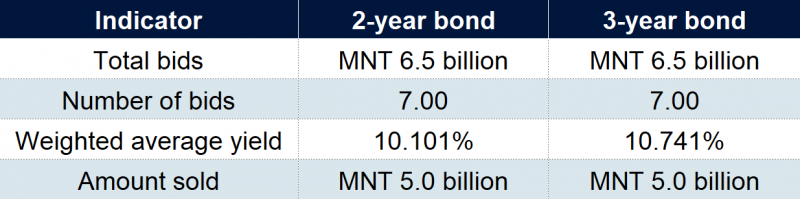
A total of ₮10 billion (100,000 securities) was sold, with weighted average yields of 10.101% (2-year) and 10.741% (3-year). Secondary market trading of these securities began on July 9.
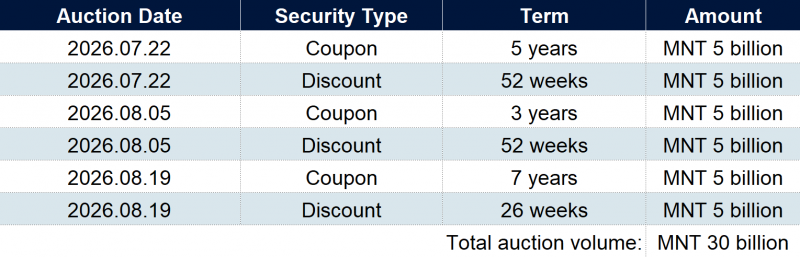
Per the Government's domestic securities issuance schedule, ₮70 billion in coupon and discount securities will be traded in Q3 2026. Investors can invest in these securities through MICC.
Government securities auction schedule, July 22 – August 19, 2026:
Between July 6–19, global stock markets were mainly driven by sell-offs in AI and semiconductor stocks. Growing caution over high valuations in the AI sector and concerns about investment returns put pressure on tech stocks, and investors were observed shifting toward defensive and traditional sectors.
U.S. STOCK MARKET
- S&P 500: -0.17%
- Dow Jones: +1.33%
- Nasdaq: -3.46%
Over the two-week period from July 6 to July 19, 2026, performance across major U.S. equity indices was mixed. The Nasdaq declined sharply by 3.46%, primarily driven by sell-offs in AI-related and semiconductor stocks. Investors became increasingly cautious about whether the elevated valuations and substantial capital expenditures supporting the AI-driven rally can continue to deliver the strong returns currently priced into the market.
Meanwhile, a rotation of capital away from high-growth technology stocks and into more traditional sectors such as financials, industrials, and healthcare supported the Dow Jones Industrial Average, which gained 1.33% during the period. The broader S&P 500 remained relatively stable, slipping only 0.17%, as gains in non-technology sectors helped offset weakness in large-cap tech names.
Overall, the July 6-19 period was characterized by a sector rotation from high-valuation technology stocks toward more defensive and value-oriented sectors, reflecting a more cautious investor sentiment toward the sustainability of the AI-led market rally.
EUROPEAN STOCK MARKET
- FTSE 100: -0.73%
- STOXX Europe 600: -1.73%
- DAX 40 (Герман): -3.80%
- CAC 40 (Франц): -2.13%
European equity markets also posted negative returns during the two-week period from July 6 to July 19, 2026. The decline was led by Germany's DAX 40, which fell 3.80%, reflecting weakness in technology, industrial, and export-oriented companies. The broader STOXX Europe 600 lost 1.73%, while France's CAC 40 and the UK's FTSE 100 declined by 2.13% and 0.73%, respectively.
Market sentiment was pressured by the global sell-off in technology and semiconductor-related stocks, which affected several major European companies with exposure to the technology supply chain. In addition, concerns over the sustainability of global economic growth, coupled with uncertainty surrounding trade conditions and corporate earnings prospects, weighed on investor confidence across the region.
Overall, European markets mirrored the cautious tone seen in global equities, as investors reduced exposure to cyclical and growth-sensitive sectors amid increasing concerns about the near-term economic outlook and the durability of the AI-driven technology rally.
ASIAN STOCK MARKET
- Nikkei 225: -8.34%
- KOSPI: -16.69%
- CSI 300: -6.97%
- SSEC : -7.27%
Asian equity markets recorded the sharpest declines among major global regions during the two-week period from July 6 to July 19, 2026. The downturn was led by South Korea's KOSPI, which plunged 16.69%, reflecting heavy selling pressure in AI-related and semiconductor stocks, sectors that represent a significant share of the Korean market. The decline was further amplified by the unwinding of leveraged positions as investors moved to reduce risk amid heightened market volatility.
Japan's Nikkei 225 also fell significantly, declining 8.34% as weakness in global technology stocks weighed on major Japanese semiconductor equipment manufacturers and export-oriented companies. In China, the CSI 300 and Shanghai Composite Index (SSEC) declined 6.97% and 7.27%, respectively, as deteriorating risk sentiment and concerns about global growth prospects reduced investor appetite for equities.
Overall, the July 6-19 period was characterized by a broad risk-off environment across Asian markets. The combination of a global technology sector sell-off, pressure on semiconductor stocks, deleveraging activity, and growing uncertainty surrounding the global economic outlook contributed to substantial losses across the region, with South Korea experiencing the most pronounced correction.
⇒ US CONSUMER PRICE INDEX REPORT RELEASED
June CPI came in at 3.5%, below the forecast of 3.8%. However, much of this improvement is considered temporary, linked to lower gasoline prices during the Iran ceasefire negotiations.
Gasoline prices rose from $3.79 to $3.86 per gallon over the week, which could put renewed upward pressure on July's inflation figure.
Core inflation (excluding food and energy) eased slightly to 2.6%, but remains above the Federal Reserve's 2% target. Economists believe declines in some components, such as auto insurance and cigarette prices, may be temporary fluctuations rather than a sustained trend.
On monetary policy, expectations predominantly favor the Fed holding its policy rate steady at 3.50%–3.75% this month. However, since energy price increases stemming from geopolitical conflict could add to inflationary pressure, the market estimates roughly a 60% probability of a rate hike continuing in September. Inflationary pressure has therefore not fully subsided, and there is a risk inflation could rise again in July.
⇒ CONCERNS GROW OVER SUSTAINABILITY OF AI INVESTMENT GROWTH
On July 7, 2026, investors grew uncertain about whether the sharp rally in AI-related tech and semiconductor stocks would continue, weakening sector-wide market expectations. Although Samsung Electronics' Q2 operating profit was expected to rise 19-fold year-over-year to ₩89.4 trillion, this fueled investor caution about whether demand for AI-related chips would remain sustainable, rather than easing it.
Investors noted that if supply constraints on key components such as memory chips ease, demand for AI chips and manufacturer profitability growth could slow. Additionally, news that China's DeepSeek is developing its own AI chips added further uncertainty about future demand for major chipmakers.
Growing doubts about the AI sector's high valuations and growth expectations could reduce investor appetite for riskier assets such as emerging-market stocks and bonds.