Weekly market news 07/06/2026
Weekly market news 07/06/2026

- Overview of the Mongolian Stock Exchange.
- Rio Tinto and the Government of Mongolia reach an agreement on adjusting the Oyu Tolgoi shareholder loan interest rate.
- The Bank of Mongolia successfully participates in the "Unlock the Mongolian Economy" expanded conference.
- The Financial Regulatory Commission approves its 2026–2029 Strategic Plan.
- Weaker-than-expected U.S. labor market data raises the likelihood that the Federal Reserve will keep interest rates unchanged.
- Apple's plans for a new phone model boost the company's market valuation by USD 210 billion, while concerns over AI infrastructure weigh on chipmakers.
- Global Stock Markets Overview.
► MONGOLIAN STOCK EXCHANGE
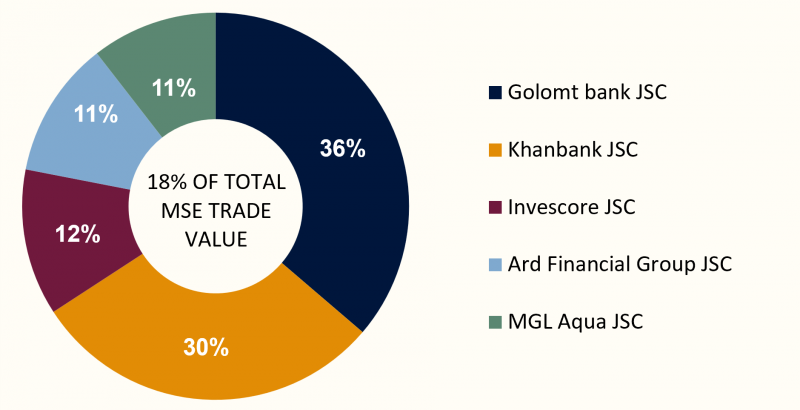
Over the course of the week, a total of 5.6 million securities with a combined value of MNT 13.3 billion were traded on the Mongolian Stock Exchange. In terms of trading value, Golomt Bank JSC, Khan Bank JSC, Invescore NBFI JSC, Ard Financial Group JSC, and MGL Aqua JSC led the market. During the period, three block trade was executed.
- Golomt Bank JSC (GLMT): 500,000 shares were traded at MNT 1,285 per share, for a total of MNT 736.6 million; the security had a trading value of MNT 250 million;
- Invescore NBFI JSC (INV): 30,865 shares were traded at MNT 8,100 per share, for a total of MNT 250.0 million; the security had a trading value of MNT 291.5 million;
- MGL Aqua JSC (MGLA): 1.1 million shares were traded at MNT 215 per share, for a total of MNT 250.0 million; the security had a trading value of MNT 250 million.
The Mongolian Stock Exchange indices closed the week lower across the board. The TOP-20 Index fell 1.43% to 51,773.38 points, indicating that demand for leading stocks weakened and profit-taking dominated. The MSE A Index declined 0.28%, reflecting modest selling activity in mid-tier companies' shares as well. The MSE B Index dropped 0.56%, showing a somewhat larger degree of profit-taking in small-cap stocks. The FTI Index, however, was the sole index to post a positive result, rising 0.18%, indicating that investment fund unit valuations remained relatively stable and even edged slightly higher.
Overall, market activity suggests that investors generally turned risk-averse, with a pullback particularly evident in leading and large-cap stocks, while investment fund products maintained relative stability.
| INDEX | POINTS | WEEKLY CHANGE |
| TOP 20 Index | 51,773.38 | -1.43% |
| MSE A Index | 19,929.76 | -0.28% |
| MSE B Index | 14,090.78 | -0.56% |
| FTI Index | 1,029.50 | +0.18% |
⇒ RIO TINTO AND THE GOVERNMENT OF MONGOLIA REACH AGREEMENT ON OYU TOLGOI SHAREHOLDER LOAN INTEREST RATE
Rio Tinto and the Government of Mongolia have reached an agreement on adjusting the interest rate on the Oyu Tolgoi project's shareholder loan. The parties also agreed to work together to resolve the Entrée mine site ownership issue in a timely manner and decided to move up the timeline for dividend distribution.
- Scope of the agreement: adjusting the loan interest rate, resolving the Entrée ownership issue, and moving up the dividend distribution timeline
- Mine production target (2028–2036): an average of ~500,000 tonnes of copper per year
- Number of employees: ~17,000 (97.8% are Mongolian nationals)
- Taxes and fees paid to the state budget (since 2010): USD 6.1 billion
Rio Tinto's Chief Executive of Copper, Katie Jackson, noted that this agreement, together with the agreement in principle reached in May on management fees, reflects Oyu Tolgoi's long-term success and the partners' commitment to their partnership.
From a capital markets perspective, this development could enhance the financial stability and transparency of the project, reduce risk, and further strengthen foreign investor confidence.
⇒ THE BANK OF MONGOLIA SUCCESSFULLY PARTICIPATES IN THE "UNLOCK THE MONGOLIAN ECONOMY" EXPANDED CONFERENCE
The "Unlock the Mongolian Economy" expanded conference, organized by the Economic Council under the Prime Minister, was successfully held on June 29–30, 2026. The event brought together representatives of Mongolia's private sector alongside more than 120 foreign investors.
- Total value of the conference: USD 545 million (total value of signed agreements and memoranda)
- Number of documents signed: 6
- Foreign investors in attendance: more than 120
- New entrants: Phillip Capital fund of Singapore, OTP Bank of Hungary
On the first day of the conference, the parties signed six investment cooperation agreements and memoranda. In addition, Singapore's Phillip Capital fund decided to open an office in Mongolia, and Hungary's OTP Bank submitted a request to Prime Minister N. Uchral to establish a branch in Mongolia, signaling growing interest from foreign banks and financial institutions in the domestic market.
OTP Bank board member László Wolf stated that, should the bank begin operating in the Mongolian market, it is interested in providing financing for major projects and offering mortgage products. While he noted it is still early to consider the current legal environment fully favorable, he pointed out that the steps already taken by the Government and the Bank of Mongolia to liberalize relevant laws and regulations are increasing opportunities for the bank.
Overall, the conference aimed to improve the investment environment, expand regional and international cooperation, and identify new public-private partnership opportunities. The growing interest of foreign financial institutions in the Mongolian market is expected to have a positive effect on the domestic capital and banking sectors going forward.
⇒ FRC APPROVES ITS 2026–2029 STRATEGIC PLAN
The Financial Regulatory Commission has approved an updated "Strategic Plan 2026–2029," aimed at supporting the development of regulated sectors and building a stable financial market system that earns public trust. The plan covers a total of 40 measures organized around 3 priority directions and 6 strategic objectives.
- Priority Direction 1: Ensuring the sustainable development of financial markets
This includes measures to revise relevant legislation to deepen financial markets and to strengthen the legal environment protecting the rights of investors and consumers. Focus areas include establishing a legal framework for Real Estate Investment Trusts (REITs), promoting green and sustainable financial products, and developing financial technology innovation. To improve financial infrastructure, the plan sets objectives to refine the legal framework for cybersecurity, introduce new risk-based supervisory and regulatory tools, and improve access to market information.
- Priority Direction 2: Strengthening public trust
This includes measures aimed at preventing systemic risk by strengthening the governance and capacity of market participants. Specific objectives include improving the legal framework for corporate governance, aligning anti-money laundering and counter-terrorism financing efforts with international standards, and strengthening the capacity of financial institutions. In parallel, the plan will improve the quality of professional training to optimize human resources, financial, and operational requirements, and establish a unified human resources database for regulatory bodies.
- Priority Direction 3: Building a continuously developing institution
To strengthen the Commission's institutional capacity and reputation, the plan includes measures to update the Commission's legal status, train qualified staff, align internal audit practices with international standards, and introduce big data and AI-based research and analysis tools. To improve cross-sectoral coordination, the plan sets objectives to expand cooperation with foreign and domestic institutions and implement joint projects and programs.
Successful implementation of this strategic plan is expected to further refine the legal and regulatory environment for financial markets, creating favorable conditions for the development of new technology-based products and services. It is also expected to fully establish a risk-based supervisory and regulatory system, strengthening the overall stability of the financial sector.
Over the past week, global equity markets saw a resurgence in risk appetite, with most major indices closing higher. While monetary policy uncertainty continued to weigh on sentiment, easing geopolitical tensions and stable energy prices helped boost investor confidence. European markets delivered the strongest performance of the week, while Asian markets were mixed.
U.S. STOCK MARKET
- S&P 500: +1.40%
- Dow Jones: +1.82%
- Nasdaq: +0.59%
U.S. markets closed the week higher across the board. The Dow Jones led performance, supported by resilient economic data and solid corporate earnings. The S&P 500 also posted solid gains, while the Nasdaq lagged relatively but still finished positive, lingering caution around stretched tech valuations was offset by renewed buying interest. Uncertainty around the Federal Reserve's rate path persisted, but overall investors rotated back into riskier assets, contributing to the week's positive close.
EUROPEAN STOCK MARKET
- FTSE 100: +1.56%
- STOXX Europe 600: +2.78%
- DAX 40 (Герман): +4.28%
- CAC 40 (Франц): +1.54%
European markets posted the strongest gains globally this week. Germany's DAX 40 led the pack, boosted by falling energy prices and positive news from export-oriented companies. The STOXX Europe 600 reflected broad-based gains across the region, with banking and industrial sectors providing key support. The FTSE 100 and CAC 40 also finished in positive territory, though investors remain focused on upcoming Eurozone inflation data and the European Central Bank's next policy signals.
ASIAN STOCK MARKET
- Nikkei 225: +1.18%
- KOSPI: -1.49%
- CSI 300: -0.59%
- SSEC : +0.24%
Asian markets were mixed over the week. Japan's Nikkei 225 rose, supported by yen stability and strength in export-driven companies. South Korea's KOSPI, however, underperformed the region, weighed down by selling pressure in tech and semiconductor stocks. China's CSI 300 also slipped, while the SSEC posted a modest gain, reflecting the tension between ongoing weakness in the property sector and expectations of new stimulus measures to support the economy.
⇒ DOW HITS RECORD HIGH AS WEAK JUNE JOBS REPORT REINFORCES FED PAUSE BETS
U.S. stocks diverged this week as investors digested a June jobs report that came in well short of expectations, reinforcing hopes that the Federal Reserve will hold rates steady rather than resume hikes. The economy added just 57,000 jobs in June, far below the 113,000–115,000 consensus estimate, though the unemployment rate actually dipped to 4.2% from 4.3%. The Dow Jones Industrial Average surged roughly 600 points, or 1.14%, to a fresh record close near 52,900, while the S&P 500 was essentially flat.
The Nasdaq told a different story, falling nearly 1% as a chip-sector sell-off deepened for a second straight session. Semiconductor stocks were hit hard after South Korea's Kospi index plunged as much as 7–7.9%, with traders growing increasingly nervous about how much longer the AI-driven spending boom can be sustained. Chipmakers including AMD, Micron, and Intel all extended declines, while Tesla shares dropped about 7% despite beating quarterly delivery estimates.
Federal Reserve Chair Kevin Warsh has urged markets to focus on incoming data rather than central bank guidance to gauge the path of interest rates, and the softer labor reading broke a three-month hot streak in job growth, strengthening the case for the Fed to keep rates on hold for now. Separately, gold is benefiting from the shifting rate outlook, on pace for its first weekly gain in a month as investors lean back toward safe havens amid the uncertainty.
⇒ APPLE'S FOLDABLE IPHONE BET ADDS $210 BILLION IN MARKET VALUE AS AI CAPACITY FEARS RATTLE CHIPMAKERS
Apple shares surged 4.84% on July 4 after reports emerged that the company plans to manufacture 10 million foldable iPhones this year, each expected to sell for around $2,500. The rally added roughly $210 billion to Apple's market capitalization in a single session, pushing the company close to a $4.54 trillion valuation and a price-to-earnings ratio of 37. Investors appear to be betting on a broader upgrade cycle beyond just the new device itself.
The optimism around Apple stood in contrast to renewed jitters elsewhere in tech. Meta Platforms' announcement that it plans to sell excess computing power stoked fears of overbuilt AI infrastructure, adding to pressure on chip stocks that were already sliding for a second consecutive session. The worry is compounded by South Korea's Kospi index, which tumbled sharply this week as traders questioned how much longer the AI investment boom can be sustained at its current pace.
Despite the volatility in individual sectors, broader market fundamentals remain solid: factory orders in May fell less than expected, and Bloomberg Intelligence projects S&P 500 second-quarter earnings growth of 23%, with AI infrastructure spending expected to drive nearly 60% of that gain. Meanwhile, crude oil has slid to its lowest level in more than four months as global supply rises, offering some relief on the inflation front even as "Trumpflation" concerns tied to earlier military action against Iran continue to linger in the background.
Federal Reserve Chair Kevin Warsh has urged markets to focus on incoming data rather than central bank guidance to gauge the path of interest rates, and the softer labor reading broke a three-month hot streak in job growth, strengthening the case for the Fed to keep rates on hold for now. Separately, gold is benefiting from the shifting rate outlook, on pace for its first weekly gain in a month as investors lean back toward safe havens amid the uncertainty.