Weekly market news 24/08/2026
Weekly market news 24/08/2026

- Overview of the Mongolian Stock Exchange.
- Fitch affirms Mongolia’s sovereign credit rating at “B+” with a “Stable” Outlook.
- Companies announcing dividend distributions for 1h 2026
- Mongolia’s GDP grew by 7.7% in the first half of 2026.
- U.S. government debt surpasses $40 trillion, adding to fiscal pressures.
- AI investment growth continues, with market focus shifting toward returns.
- Overview of global stock markets.
► MONGOLIAN STOCK EXCHANGE
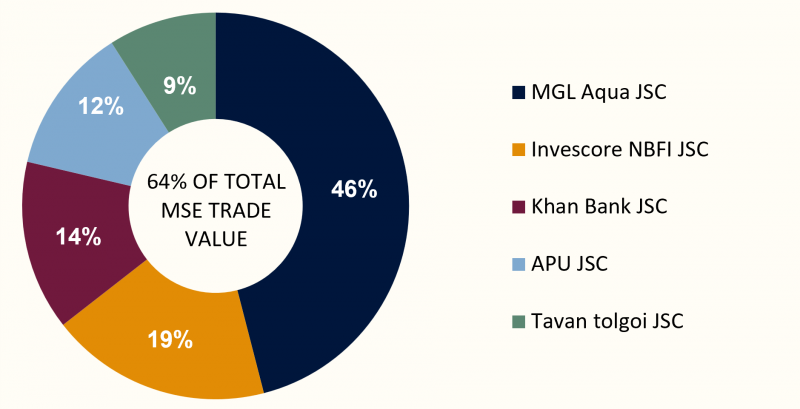
Over the course of the week, a total of 23.4 million securities with a combined value of MNT 11.4 billion were traded on the Mongolian Stock Exchange. By trading value, MGL Aqua JSC, Invescore NBFI JSC, Khan Bank JSC, APU JSC, and Tavantolgoi JSC were the most actively traded securities. A total of three block trades were executed during the period, as follows:
- MGL Aqua JSC (MGLA) – 1.63 million securities at MNT 300 per share, totaling MNT 489 million;
- MGL Aqua JSC (MGLA) – 7.18 million securities at MNT 263.82 per share, totaling MNT 1.9 billion;
- APU JSC (APU) – 490,000 securities at MNT 1,020 per share, totaling MNT 500 million.
Mongolia’s equity market delivered a mixed performance last week. The TOP-20 Index rose 1.78% to 56,664.44, while the MSE A Index increased 1.64% to 21,645.31, indicating relatively strong buying activity in leading and large-cap listed companies. Meanwhile, the MSE B Index edged down 0.12% to 14,600.07, while the FTI Index declined 1.82% to 1,063.70. Overall, most major market indices recorded gains, although performance remained uneven across segments, with investor interest appearing more concentrated in larger and leading securities.
| INDEX | INDEX | INDEX |
| TOP 20 Index | 56,664.44 | +1.78% |
| MSE A Index | 21,645.31 | +1.64% |
| MSE B Index | 14,600.07 | -0.12% |
| FTI Index | 1,063.70 | -1.82% |
⇒ FITCH AFFIRMS MONGOLIA’S “B+” SOVEREIGN RATING WITH A “STABLE” OUTLOOK
On August 19, 2026, Fitch Ratings affirmed Mongolia’s Long-Term Foreign-Currency Issuer Default Rating at “B+” with a “Stable” Outlook.
Fitch views Mongolia’s medium-term growth prospects as a key credit strength, forecasting 5.6% economic growth in 2026 and around 5.5% over the medium term. Mining investment, the expansion of underground operations at Oyu Tolgoi, and strong copper and gold exports are expected to remain the main drivers of growth.
However, Mongolia’s high dependence on Chinese commodity demand and external financing remains a key credit vulnerability. Fitch expects average inflation of 10% in 2026, while the fiscal balance is projected to shift to a 2.2% of GDP deficit in 2026 and widen to 3.3% in 2027. Although foreign-exchange reserves reached $8.0 billion in July, Fitch noted that they cover less than four months of current account payments.
The “B+ / Stable” rating reflects Mongolia’s strong mining-led growth outlook while highlighting structural risks related to external debt, commodity concentration, fiscal pressures, and political uncertainty. Further strengthening foreign-exchange reserves, maintaining prudent fiscal policy, and reducing external financing vulnerabilities will remain important for a potential future upgrade.
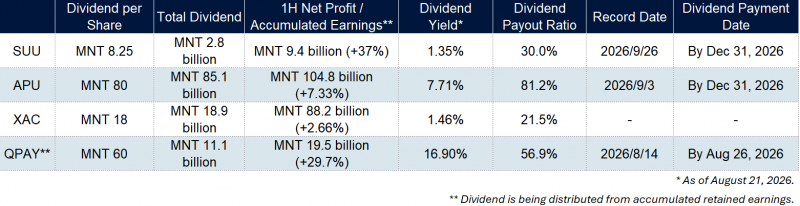
⇒ COMPANIES ANNOUNCING DIVIDEND DISTRIBUTIONS FOR 1H 2026
As of August 24, 2026, the following companies listed on the Mongolian Stock Exchange have officially announced, through resolutions of their Boards of Directors, their decisions to distribute dividends from their after-tax net profit for the first half of 2026 and/or accumulated retained earnings.
⇒ MONGOLIA’S GDP GREW BY 7.7% IN THE FIRST HALF OF 2026.
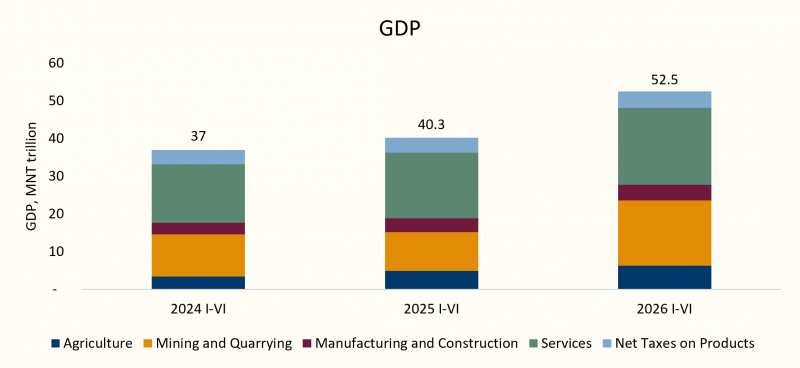
Mongolia’s economy grew by 7.7% in the first half of 2026, accelerating from the 5.6% growth recorded in the same period of the previous year. According to preliminary half-year estimates, GDP reached MNT 52.5 trillion. The mining sector was the main driver of growth, contributing 3.9 percentage points. The services sector also supported economic growth, contributing 1.8 percentage points, although its growth was relatively weaker compared with the mining sector.
Global equity markets delivered a broadly negative performance last week. Most major indices across the U.S., Europe, and Asia declined, with technology-heavy markets experiencing the sharpest losses. The downturn was primarily driven by rising U.S. Treasury yields, concerns over elevated valuations in technology stocks, and geopolitical risks in the Middle East.
U.S. STOCK MARKET
- S&P 500: -1.49%
- Dow Jones: -0.72%
- Nasdaq: -2.26%
The U.S. equity market posted broad-based losses during the week. The S&P 500 fell 1.49%, the Dow Jones Industrial Average declined 0.72%, and the Nasdaq dropped 2.26%, making it the weakest-performing major index. Rising long-term U.S. Treasury yields and higher oil prices weighed on equity valuations. In particular, the yield on the 30-year U.S. Treasury bond approached 5.3%, near its highest level since 2007, putting significant pressure on high-growth and technology stocks. Concerns over stretched AI-related and technology stock valuations further accelerated the decline in the Nasdaq. In addition, escalating geopolitical tensions between the United States and Iran contributed to higher oil prices and encouraged a more risk-averse stance among investors.
EUROPEAN STOCK MARKET
- FTSE 100: +0.62%
- STOXX Europe 600: -0.67%
- DAX 40: -1.34%
- CAC 40: -1.67%
European equity markets delivered mixed results during the week. The UK's FTSE 100 gained 0.62%, while the STOXX Europe 600, Germany's DAX 40, and France's CAC 40 declined by 0.67%, 1.34%, and 1.67%, respectively. Elevated U.S. Treasury yields and persistently high oil prices increased concerns about inflationary pressures and reduced expectations for monetary policy easing, weighing on equity markets across the region. However, stronger-than-expected economic activity in the Eurozone and relatively resilient corporate earnings helped limit the overall decline. The FTSE 100 outperformed its continental peers, supported by gains in mining stocks as gold and base metal prices moved higher.
ASIAN STOCK MARKET
- Nikkei 225: -4.16%
- KOSPI: -3.01%
- CSI 300: -1.14%
- SSEC: -0.63%
Asian equity markets broadly moved lower during the week. Japan's Nikkei 225 fell 4.16% and South Korea's KOSPI declined 3.01%, marking the steepest losses among major regional indices. China's CSI 300 and Shanghai Composite Index dropped 1.14% and 0.63%, respectively. The technology- and export-oriented nature of the Japanese and South Korean markets made them particularly vulnerable to weakness in U.S. technology stocks and rising global bond yields. Rising oil prices, driven by geopolitical tensions involving Iran and uncertainty surrounding the Strait of Hormuz, also increased concerns about higher energy costs and slower economic growth across Asia. Overall, investors adopted a more defensive posture, resulting in widespread selling pressure throughout the region.
⇒ ️ U.S. GOVERNMENT DEBT SURPASSES $40 TRILLION, ADDING TO FISCAL PRESSURES
U.S. national debt surpassed $40 trillion for the first time on August 18, 2026, reaching $40.047 trillion, according to the U.S. Treasury. Of this amount, approximately $32.3 trillion is debt held by the public, while $7.8 trillion represents intragovernmental debt. Total debt has doubled since 2017.
The increase is affecting the economy not only through the size of the debt itself, but also through higher government financing costs. The federal budget deficit reached $1.8 trillion during the first 10 months of fiscal year 2026, including a $432 billion deficit in July. Meanwhile, the 30-year Treasury yield reached 5.216% in mid-August, among its highest levels since 2001, indicating that investors are demanding higher returns to hold longer-term government debt.
As debt increases, rising interest payments could consume a larger share of federal spending and reduce fiscal room for areas such as infrastructure and education. Higher long-term Treasury yields can also feed through to mortgage rates, corporate financing costs, and other borrowing costs. Elevated debt levels, persistent fiscal deficits, and inflation risks are among the factors contributing to higher Treasury yields.
The $40 trillion milestone does not by itself signal an economic crisis, but it highlights the growing challenge of maintaining long-term fiscal sustainability. If debt and interest costs continue to rise while long-term yields remain elevated, higher refinancing costs could place additional pressure on fiscal policy and private-sector financing conditions.
⇒ AI INVESTMENT CONTINUES TO EXPAND, WITH MARKET FOCUS SHIFTING TOWARD RETURNS
Investment in artificial intelligence continues to accelerate, but investor attention is increasingly shifting from the scale of AI spending toward which companies can convert these investments into sustainable revenue and profits. According to Reuters, recent results from Microsoft and Amazon indicate that demand for AI infrastructure remains strong, easing some concerns among major investors about the sector.
Investment in AI data-centre infrastructure is also expanding. CoreWeave's backlog reached $104.2 billion in the second quarter of 2026, highlighting continued demand for computing capacity and contributing to strong valuations across AI infrastructure companies.
At the same time, the sector requires substantial capital and financing. Nvidia is working with financial institutions on initiatives aimed at mobilizing more than $500 billion for AI infrastructure, underscoring the scale of capital required to support continued expansion. However, high valuations and uncertain returns remain key risks, particularly for AI companies relying heavily on debt financing.