Weekly market news 03/16/2026
Weekly market news 03/16/2026

- Overview of trading activity on the Mongolian Stock Exchange.
- Inflation in Mongolia eased to 6.5% in February 2026, though rising food prices remain the main contributor to inflationary pressure.
- Mongolia’s exports surpassed USD 3 billion, marking a 51.9% increase year-on-year, largely driven by higher coal shipments.
- Coal exports continued to expand, with average daily exports reaching around 320,000–330,000 tonnes.
- Geopolitical tensions in the Middle East have increased pressure on global oil markets, raising concerns about potential price volatility.
- NVIDIA announced a strategic partnership with Nebius, committing USD 2 billion in investment to expand next-generation AI and cloud computing infrastructure.
- Overview of global capital markets.
► MONGOLIAN STOCK EXCHANGE
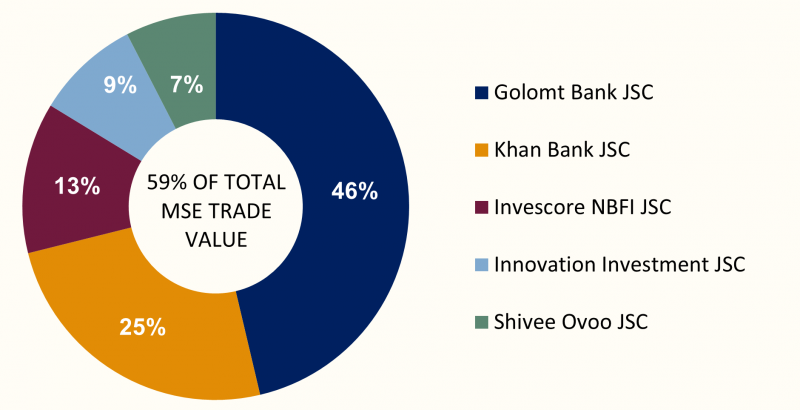
Over the course of the week, a total of 5.9 million securities with a combined value of MNT 7.1 billion were traded on the Mongolian Stock Exchange. In terms of trading value, the most actively traded companies were Golomt Bank JSC, Khan Bank JSC, Invescore NBFI JSC, Innovation Investment JSC, and Shivee Ovoo JSC. During the same period, two block trades were executed:
- • Invescore NBFI JSC (INV) traded 56.8 thousand shares at MNT 8,800 per share, amounting to MNT 500 million in total turnover.
- • Golomt Bank JSC (GLMT) saw 533 thousand shares traded at MNT 1,295 per share, generating approximately MNT 690 million in trading value.
The Mongolian Stock Exchange’s key indices closed the week higher. The TOP-20 Index reached 52,802.39 points, increasing by 0.29%, while the MSE A Index rose 0.45% to 20,269.60 points. The MSE B Index also gained 0.42%, closing at 14,535.12 points. The broad-based gains across the main indices indicate improving investor activity and generally stable sentiment in the domestic equity market.
| INDEX | POINTS | WEEKLY CHANGE |
| TOP 20 Index | 52,802.39 | +0.29% |
| MSE A Index | 20,269.60 | +0.45% |
| MSE B Index | 14,535.12 | +0.42% |
⇒ INFLATION EASES TO 6.5% AS PRICE PRESSURES MODERATE
According to the National Statistics Office, consumer prices in Mongolia increased by 6.5% year-on-year in February 2026, while rising 0.5% compared with the previous month. This marks a slowdown from 9.6% inflation recorded in February 2025, indicating that the pace of price growth has moderated.
Despite the slowdown, food prices remain the main driver of inflation. The food, beverages and water category contributed 3.3 percentage points, accounting for around 51% of total inflation, while clothing, textiles and footwear added 0.8 percentage points (12.9%).
Key indicators
- Annual inflation rate: 6.5%
- Monthly increase: 0.5%
- Goods prices: +6.3%
- Services prices: +7.0%
Regional highlights
- Central region – goods prices: +8.2%
- Western region – services prices: +8.4%
- Ulaanbaatar – food prices: +12.8%
- Western region – non-food goods: +6.0%
Breaking down the inflation structure, domestically produced goods excluding meat and solid fuels contributed 3.3 percentage points (51.2%), while imported goods excluding fuel contributed 1.2 percentage points (17.8%) to overall inflation. The easing in inflation suggests that tight monetary policy conditions are beginning to take effect. However, persistently high food prices indicate that household cost pressures may remain elevated in the medium term, posing a continued risk to inflation stability.
⇒ EXPORTS SURGE OVER 50% AS FOREIGN TRADE EXPANDS
According to the General Customs Administration, Mongolia’s total foreign trade turnover reached USD 4.6 billion in the first two months of 2026, marking an increase of USD 906.5 million or 24.4% year-on-year. As exports significantly exceeded imports, the trade balance recorded a surplus of USD 1.5 billion.
During the same period, Mongolia exported USD 3.05 billion worth of goods and commodities, representing a 51.9% increase compared with the same period last year. The growth was largely driven by higher shipments of mining products, particularly a sharp increase in coal exports.
Key indicators
- Total foreign trade turnover: USD 4.6 billion
- Exports: USD 3.046 billion (+51.9%)
- Trade balance: USD 1.5 billion surplus
Export composition
- Coal: 15.8 million tonnes exported, generating USD 1.0 billion in revenue, up 54.4% year-on-year
- Copper concentrate: 42 thousand tonnes exported, generating USD 1.4 billion
- Crude oil: 0.52 million barrels exported, down 14.5% year-on-year
Coal and copper concentrate together accounted for around 80% of Mongolia’s export revenue, remaining the key drivers of the country’s external trade performance. The strong growth in coal exports is mainly attributed to robust demand from China and improvements in transportation and logistics capacity.
While the surge in exports is supporting Mongolia’s foreign currency inflows and balance of payments, the heavy reliance on mining products highlights the economy’s continued vulnerability to commodity price volatility in global markets.
⇒ COAL EXPORTS RISE AS DAILY SHIPMENTS REACH 320–330 THOUSAND TONNES
According to the Ministry of Economy and Development, Mongolia’s coal exports recorded notable growth in the early months of 2026, remaining the main driver of the country’s export performance. In January, coal exports reached 10 million tonnes, representing a 73% increase compared with 5.8 million tonnes in the same period last year, with average daily exports of around 326 thousand tonnes.
In February, coal exports totaled 6.4 million tonnes, up 11% year-on-year from 5.7 million tonnes. Although the export volume was partly affected by overlapping Lunar New Year holidays in both Mongolia and China and the shorter number of days in the month, the adjusted daily export level remained strong at around 320 thousand tonnes.
Key indicators
- January 2026: 10 million tonnes exported (+73% YoY)
- February 2026: 6.4 million tonnes exported (+11% YoY)
- Average daily exports: 320–326 thousand tonnes
- As of March 10: 3 million tonnes exported, 2.6 times higher year-on-year
The Ministry of Road and Transport Development also noted that the Gashuunsukhait–Gantsmod cross-border railway connection, once operational, could increase Mongolia’s rail-based coal export capacity by up to 30 million tonnes annually. This is expected to reduce transportation costs and potentially boost export revenue by around USD 1.5 billion, providing additional support to economic growth.
The construction of the railway project is currently about 10% complete, with ongoing infrastructure works. As logistics capacity expands alongside rising coal shipments, Mongolia’s export revenues and foreign currency inflows are expected to strengthen in the medium term.
Between March 9 and 13, 2026, global equity markets showed divergent regional performance. U.S. markets declined amid geopolitical tensions, rising oil prices, and uncertainty around the Federal Reserve’s policy outlook. European markets remained relatively stable with support from energy and industrial stocks, while Asian markets delivered mixed results as technology sector gains and expectations of policy support in China were offset by currency volatility in Japan.
U.S. STOCK MARKET
- S&P 500: -1.00%
- Dow Jones: -1.72%
- Nasdaq: -0.50%
U.S. equity markets ended the week lower as investors reacted to heightened geopolitical tensions in the Middle East, rising oil prices, and continued uncertainty regarding the Federal Reserve’s monetary policy path. Concerns that inflation could remain elevated and that interest rates may stay higher for longer triggered profit-taking in technology and large-cap stocks, weighing on broader market performance.
EUROPEAN STOCK MARKET
- FTSE 100: +0.11%
- STOXX Europe 600: +0.33%
- DAX 40 (Герман): +1.95%
- CAC 40 (Франц): -0.05%
European markets were relatively resilient, with several major indices posting gains. Germany’s DAX led regional performance, supported by strong momentum in industrial and export-oriented companies. Rising energy prices also boosted shares of energy and commodity producers, although investor caution persisted in France, leaving the CAC 40 slightly lower by the end of the week.
ASIAN STOCK MARKET
- Nikkei 225: -1.44%
- KOSPI: +4.21%
- CSI 300: +1.50%
- SSEC : -0.08%
European markets were relatively resilient, with several major indices posting gains. Germany’s DAX led regional performance, supported by strong momentum in industrial and export-oriented companies. Rising energy prices also boosted shares of energy and commodity producers, although investor caution persisted in France, leaving the CAC 40 slightly lower by the end of the week.
⇒ MIDDLE EAST TENSIONS PUT PRESSURE ON OIL MARKETS, RAISING PRICE RISKS
Rising geopolitical tensions in the Middle East have increased uncertainty in global oil markets following reports of attacks on commercial vessels in the Persian Gulf. Analysts warn that if the situation escalates further, oil prices could potentially surge toward USD 200 per barrel, while Iranian officials have cautioned that continued conflict in the region could seriously disrupt global oil transportation routes.
According to the International Energy Agency (IEA), instability in the Persian Gulf could lead to significant disruptions in global oil supply, prompting discussions around the potential release of strategic petroleum reserves to stabilize the market if necessary. Approximately 20% of the world’s oil shipments pass through the Strait of Hormuz, making the region a critical chokepoint for global energy trade.
In recent weeks, military actions involving the United States and Israel, followed by retaliatory responses from Iran, have heightened the risk of the conflict spreading across Lebanon and the wider Gulf region. International media reports indicate that several commercial vessels in the Persian Gulf have been targeted, raising concerns about the security of oil and liquefied gas shipments.
Key factors affecting the market
- Increased security risks for maritime transportation in the Persian Gulf
- Potential disruptions to oil flows through the Strait of Hormuz
- Elevated geopolitical risk leading to uncertainty in global oil supply
Market analysts note that if the conflict intensifies and energy supply routes are disrupted, oil prices could rise sharply. Some market scenarios suggest prices could reach USD 150–200 per barrel, a level that would likely place significant upward pressure on global inflation and economic growth.
⇒ NVIDIA FORMS STRATEGIC PARTNERSHIP WITH NEBIUS, TO INVEST $2 BILLION
NVIDIA and Nebius have announced a strategic partnership aimed at expanding artificial intelligence infrastructure and developing next-generation hyperscale cloud computing platforms. Under the agreement, NVIDIA will invest approximately $2 billion in Nebius, supporting the expansion of AI-focused computing capacity.
As global demand for artificial intelligence and high-performance computing (HPC) continues to surge, the partnership is expected to accelerate the development of Nebius’s AI cloud platform. Nebius already operates gigawatt-scale AI data centers in the United States and other regions, leveraging NVIDIA’s computing infrastructure. The company plans to increase its AI computing capacity to more than 5 gigawatts by 2030.
As part of the collaboration, Nebius will integrate NVIDIA’s next-generation computing architectures, including the Rubin GPU, Vera CPU, and BlueField data processing systems, into its platform. The companies will also cooperate on AI-driven industrial solutions, data center design, and expansion of AI infrastructure.
Key highlights:
- $2 billion strategic investment from NVIDIA into Nebius
- Expansion of AI data centers and hyperscale cloud infrastructure
- Integration of Rubin GPUs, Vera CPUs, and BlueField architectures
According to analysts, rising investment in AI data centers and high-performance computing infrastructure is becoming a major growth driver for the technology sector, intensifying competition across the global AI ecosystem.